Compliance · Waste Hierarchy (Prevention, Reuse, Recycling, Recovery, Disposal)
What is the waste hierarchy?
A guide to the 5-step framework for environmental compliance and waste management
The waste hierarchy is a fundamental environmental policy framework that ranks waste management strategies from most to least preferable. It dictates that businesses must prioritise prevention and reuse before considering recycling, energy recovery, or landfill disposal.
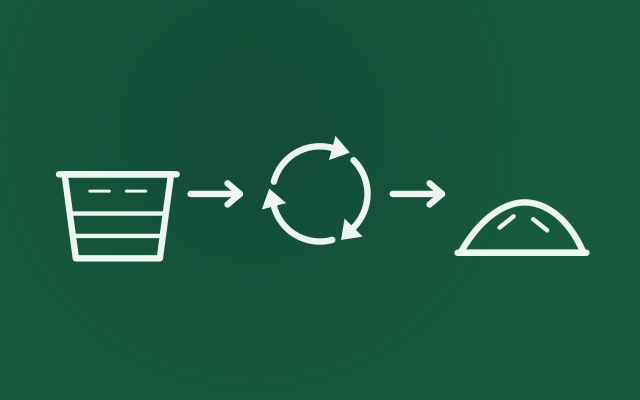
For decades, the global supply chain operated on a linear model of taking resources, making products, and throwing them away. This approach caused immense environmental strain and forced municipal governments to manage overwhelming volumes of discarded materials. As governments moved to implement circular economy principles, they needed a formal, legal structure to force commercial entities to rethink how they manage their material footprints.
The resulting hierarchy is not just a theoretical green concept; it is the legislative backbone of modern extended producer responsibility laws across Europe and beyond. For merchants selling packaged goods, this 5-step ladder determines how environmental compliance is assessed and priced. Regulators use this scale to set financial tariffs, heavily penalising brands that rely on bottom-tier disposal methods while offering commercial advantages to those who design packaging for the top tiers of prevention and reuse.
What the waste hierarchy actually means
The waste hierarchy establishes a strict order of preference for dealing with materials. At the very top sits prevention, which means reducing the amount of material used in the first place. If waste cannot be prevented entirely, the next step is preparing the item for reuse, keeping it in its existing state to extend its lifespan. If direct reuse is impossible, the material falls to the third tier, which is recycling.
"The hierarchy used in the U.K. Has five levels: reduce the amount of material used, prepare for reuse, recycle, recover other value, and, as a last resort, dispose." (Towards The Circular Economy Vol 2 | Ellen MacArthur Foundation)
When materials cannot be physically recycled into secondary raw materials, they enter the fourth tier: recovery. This typically involves processing the waste in high-temperature incinerators to generate electricity, or using anaerobic digestion to generate biogas. Finally, at the very bottom of the hierarchy sits disposal. In the European Union waste hierarchy, disposal, which includes landfill and similar operations, ranks as the absolute least preferable way of waste management (Fact sheets & background information – Page 2 – European Bioplastics e.V.).
Legal definitions strictly separate these tiers. Under European rules, material recycling is defined explicitly as any recovery operation by which waste materials are reprocessed into materials or substances, with the specific exception of energy recovery or reprocessing into materials that are to be used as fuels (Packaging and Packaging Waste Regulation (EU) 2025/40 (PDF)). Consequently, a merchant cannot claim they are recycling a product if the local facility is actually incinerating it to generate power.
Does this apply to me?
If you manufacture consumer goods, package products for e-commerce, or act as the importer of record for distance sales into a regulated market, the principles of this hierarchy apply directly to your operational costs. Extended producer responsibility schemes are built entirely upon this framework. When you register with a national compliance scheme in countries like Germany, France, or the United Kingdom, your financial tariffs are calculated based on where your packaging materials sit on this ladder.
You must actively prove that you are trying to push your materials up the hierarchy. Many modern regulations require businesses to submit formal corporate waste prevention plans or detailed supply reports demonstrating year-on-year material reductions. If you ignore the top tiers and flood the market with non-recyclable, single-use plastics that must be sent to landfill, you will face severe financial penalties known as eco-modulated fees.
Merchants cannot simply delegate this responsibility to a waste contractor. Even if a local authority physically handles the household rubbish, the merchant who placed the product on the market retains the legal and financial burden. You must understand exactly how the local municipal infrastructure processes your specific packaging formats to accurately report your data and pay the correct legal tariffs. If your packaging design disrupts the sorting facilities, your compliance costs will rise accordingly.
The 5 levels and legal definitions
Regulators define the boundaries between the different waste management tiers carefully to ensure businesses cannot misclassify their environmental impact.
| Regulatory element | Detail |
|---|---|
| Level 1: Prevention | Reduce the amount of material used in the first place. |
| Level 2: Reuse | Prepare the item for reuse in its original form. |
| Level 3: Recycling | Reprocessing waste into materials, expressly excluding energy recovery and fuels. |
| Level 4: Recovery | Recovering other value from the waste, such as generating energy or anaerobic digestion. |
| Level 5: Disposal | Landfill and similar operations, ranking as the least preferable way of waste management. |
Common misconceptions about the waste hierarchy
Recycling is the best possible environmental outcome. While consumers often view recycling as the ultimate green goal, it actually sits in the middle of the hierarchy. Embedded energy and material value are lost during the physical melting or repulping process (Glossary of Terms | Circular Economy Definitions - Ellen MacArthur Foundation). In a true circular economy, recycling is considered the last resort action for a material, sitting far below prevention and direct reuse.
Incinerating waste for power counts as recycling. Energy recovery is legally and functionally distinct from recycling. Under strict environmental definitions, converting waste into fuel or burning it to generate heat is classified as recovery, the fourth tier of the hierarchy. You cannot claim your packaging is recyclable if its only end-of-life pathway is an incinerator.
Small merchants are exempt from the hierarchy. The structural principles of the hierarchy apply to the entire commercial market. Even if a small business is exempt from paying the heaviest financial data reporting tariffs due to low sales volumes, they are still subject to overarching bans on certain single-use items that have been legally prohibited by national governments because they violate the prevention tier.
I can choose where my packaging sits on the ladder. You cannot self-declare that your product will be reused or recycled based solely on its theoretical material properties. The classification depends entirely on the physical realities of the municipal waste infrastructure in the country where the item is discarded. If the local sorting facilities cannot process your specific plastic format, the item will be sent to disposal, regardless of what you print on the box.
5 examples of the hierarchy in practice
1. Eliminating unnecessary materials (Prevention) An online electronics retailer audits its supply chain and completely removes the thick plastic inserts from its shipping boxes. By substituting them with clever cardboard folding techniques to hold the product securely, they reduce the amount of material used and directly achieve the highest tier.
2. Introducing refillable containers (Reuse) A cosmetics brand redesigns its heavy glass moisturiser jars to be kept by the consumer permanently. They sell lightweight, minimalist refill pouches that reduce overall resource consumption and keep the primary jar in continuous circulation.
3. Designing for optical sorters (Recycling) A food manufacturer switches its plastic trays from carbon black to clear plastic. This ensures that the near-infrared cameras in local recovery facilities can easily identify the resin and process it into secondary raw materials, keeping it out of the incinerator.
4. Utilising anaerobic digestion (Recovery) A municipal council collects unavoidable organic food waste and processes it through anaerobic digestion facilities. This extracts fertilising nutrients and generates biogas, capturing energy value from material that cannot be prevented or reused, which is often ranked above incineration for food waste.
5. Paying high fees for unrecyclable composites (Disposal) A snack brand continues to use complex, multi-layered foil and plastic pouches that cannot be separated by standard recycling machinery. Because the pouches inevitably end up in landfill, the brand is forced to pay the highest penalty tariffs under national producer responsibility laws.
Terms related to the Waste Hierarchy
| Term | What it means |
|---|---|
| packaging-weight-threshold-epr | The specific volume limits set by governments that determine when a merchant must officially register and pay compliance fees. |
| statutory-enforcement-verpackg | The strict legal and administrative mechanisms used by authorities to ensure businesses fund the recovery of their packaging waste. |
| free-rider-epr | An economic operator who places packaged goods on the market without paying the required recycling fees. |
| sku-level-packaging-data | The highly specific, item-by-item breakdown of the material weights required to submit accurate compliance reports. |
Frequently asked questions
What is the primary goal of the waste hierarchy?
The main objective is to extract the maximum practical benefit from products while generating the absolute minimum amount of waste. By forcing businesses to work from the top down, the framework aims to decouple economic growth from the constant extraction and consumption of virgin natural resources, preserving the environment and reducing municipal waste burdens.
Why is prevention ranked higher than recycling?
Prevention stops the waste from being created in the first place. Even the most efficient recycling systems require immense amounts of industrial energy, water, and transport logistics to collect, sort, and melt materials. Preventing the use of material altogether saves all of that embedded energy and avoids the inevitable degradation of material quality that occurs during recycling.
Does energy recovery count towards my statutory recycling targets?
No. Environmental legislation strictly separates material recycling from energy recovery. If your packaging is sent to a high-temperature incinerator to generate municipal electricity, it has been recovered, not recycled. You will not receive any credit for this outcome against your legally mandated recycling targets.
How does this affect my packaging compliance fees?
Under extended producer responsibility schemes, regulators use the hierarchy to apply eco-modulated fees. If your packaging is designed for easy reuse or high-quality recycling, you pay a lower financial tariff. If your packaging design forces the waste management sector to resort to incineration or landfill, you are penalised with significantly higher fees.
Can a single product move between different tiers?
Yes, the actual classification often depends on the local waste infrastructure. A paper carton might be easily recycled in a country with advanced paper mills, sitting comfortably at tier 3. However, if you ship that exact same carton to a region completely lacking paper recycling infrastructure, it will inevitably fall to tier 5 and be disposed of in a local landfill.
Sources:
Written by Daniel Vaknine, Co-founder – Compliance & Operations · Last reviewed 27 Jul 2026
Not sure what applies to you?
Answer a few questions about where you sell and see which packaging rules you fall under.
Check your obligations