PPWR Explained: EU Packaging Regulation 2026
The PPWR ((EU) 2025/40) applies from 12 Aug 2026. What it requires — recyclability, minimisation, labelling, reporting — and who it affects.
The PPWR Explained: The EU Packaging & Packaging Waste Regulation
The EU is changing the rules for packaging. If you ship physical goods, you need to understand the PPWR (Packaging and Packaging Waste Regulation). Taking effect on Regulation (EU) 2025/40 application date of 12 August 2026, this new law creates strict, pan-European rules for packaging design, recyclability, and reporting. Unlike previous directives, the PPWR is directly binding, meaning you cannot ignore it if you sell into the EU. This guide provides a clear PPWR summary, explaining its core requirements and who it applies to.
What is the PPWR? (A quick summary)
The Packaging and Packaging Waste Regulation, officially known as Regulation (EU) 2025/40, is a comprehensive environmental law. Its goal is to stop the rapid growth of packaging waste and drive the European market towards a circular economy.
While Extended Producer Responsibility (EPR) forces you to pay for your waste, the PPWR dictates the physical design of your packaging. Because it is a regulation rather than a directive, it applies identically across all 27 Member States according to the European Commission, harmonizing everything from minimum recycled content to how empty space is calculated in a shipping box.
When does PPWR come into force?
The regulation was officially published in the Official Journal early in 2025. However, the critical date for e-commerce sellers is the general date of application: 12 August 2026.
From this day forward, your day-one obligations begin. These include strict limits on heavy metals and PFAS in food-contact packaging, new documentation requirements (such as the Annex VII technical file and the EU Declaration of Conformity), and the first waves of mandatory labeling. Further deadlines cascade between 2028 and 2040, continually tightening the rules for recyclability and reuse.
Who does PPWR apply to?
The PPWR applies to all "economic operators" who place packaging on the EU market. Under the law, your specific obligations depend entirely on your role in the supply chain:
- Manufacturers: If you make packaging, or have it manufactured and market it under your own brand name, you carry the heaviest burden. You must draw up technical documentation and issue an EU Declaration of Conformity to prove the packaging meets all design criteria.
- Importers: If you bring packaged goods from outside the EU into the European market, you must verify that the manufacturer has completed the required conformity assessments, drawn up the necessary documents, and applied the correct labeling.
- Distributors: If you simply sell or fulfill orders, you must verify that the packaging complies with the new standards and contains the proper labeling before making it available to consumers.
Feeling overwhelmed by these upcoming regulations? Gram turns your real e-commerce orders into filing-ready reports so you can stay compliant without the headache. Join the pilot waitlist today.
Core PPWR requirements for e-commerce
To keep selling in the EU, you will need to adapt your operations to meet several strict PPWR requirements:
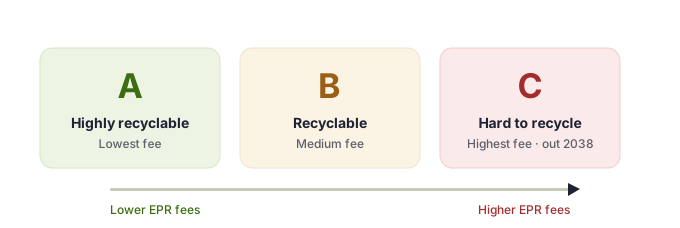
- Mandatory Recyclability (2030): All packaging placed on the market must meet design-for-recycling criteria and be assigned a recyclability grade of A, B, or C. By 2038, grade C will be phased out entirely.
- Packaging Minimisation: You must minimize the weight and volume of your packaging. The regulation will strictly limit the amount of empty space (void fill) allowed in consumer and e-commerce shipping boxes.
- Harmonised Labelling: By 2028, packaging must feature standardized labels instructing consumers on proper sorting, likely incorporating QR codes for digital verification.
- Eco-Modulation of EPR Fees: If you are wondering about EPR vs PPWR, they are deeply connected. Under PPWR, your local EPR fees will become mandatorily "eco-modulated" based on your packaging's recyclability grade. Highly recyclable packaging will cost you significantly less in fees, while hard-to-recycle materials will face steep financial penalties.
FAQ
When does PPWR come into force? The PPWR becomes generally applicable across all EU Member States on 12 August 2026.
Who does PPWR apply to? It applies to all economic operators placing packaging on the EU market, including manufacturers, importers, and distributors. If you run an e-commerce store shipping physical goods to the EU, it applies to you.
Is PPWR replacing EPR? No, the PPWR does not replace EPR; it harmonises and reinforces it. You must still register and pay fees to national authorities, but those fees will now be tied directly to new PPWR recyclability grades.
Stop doing your EPR reporting in spreadsheets. Gram automatically maps your orders to the correct country requirements and recyclability tiers. Join the Gram pilot waitlist today.
Sources: