What Is EPR? Extended Producer Responsibility Explained
EPR makes businesses pay for their packaging waste. A plain-English guide to what EPR is, who must register, and how reporting works in the EU.
What Is Extended Producer Responsibility (EPR)?
The EU is getting strict on packaging waste. If you run an e-commerce store, you've likely seen warnings about getting fined or delisted for non-compliance by the ZSVR. The culprit? Extended producer responsibility.
But what does it actually mean? In short, if you ship physical goods, you EEAS guidelines on paying for the recycling of your packaging. This plain-English guide explains what it means, who needs to register, and how to avoid penalties.
What is EPR? The simple definition.
EPR stands for Extended Producer Responsibility, an environmental policy principle that makes the "producer" financially and operationally responsible for a product's entire lifecycle. This crucially includes OECD standards for post-consumer waste management.
In the context of e-commerce and packaging, EPR regulations mean a simple rule: if you put packaging on the market, you pay for its recycling. Instead of taxpayers footing the bill, the financial burden shifts directly to the businesses Ellen MacArthur Foundation report on circular economy businesses generating the packaging.
Do I count as a "Producer"?
Many online sellers assume the word "producer" only applies to the factory manufacturing the physical item. Under EU law, the EPR producer definition is much broader.
You generally count as an obligated producer if you:
- Import or introduce a packaged product into a country.
- Pack goods into packaging, such as placing a product into a cardboard box or plastic mailer.
- Distance sell packaged goods directly to end consumers (B2C) or businesses (B2B) in a country from abroad.
Because of these broad criteria, almost all e-commerce merchants are obligated producers. If you use shipping boxes, mailers, tape, or void fill to send goods to EU customers, these EU Regulation 2025/40 packaging rules apply to you.
Are you struggling to track how much packaging you ship across different EU countries? Gram turns your real ecommerce orders into filing-ready packaging reports in minutes.
How EPR works in practice (The 4 steps)
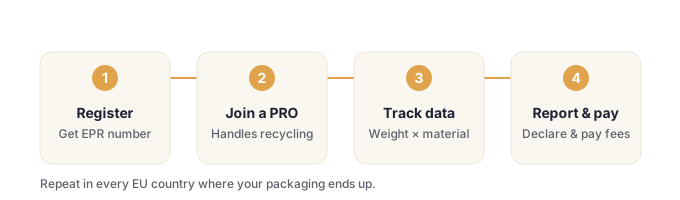
EPR compliance can feel overwhelming. However, it generally follows four concrete steps in each EU country where your packaging ends up:
- 1. Register for an EPR number: Before you sell, you must register with a national authority to get a unique EPR number. In Germany, you register in LUCID, while in Sweden, you register with the Swedish EPA Naturvårdsverket. In many countries, the obligation starts from the very first package you ship.
- 2. Join a PRO (Producer Responsibility Organisation): You must affiliate with a PRO in your target market. The PRO handles the physical recycling and reports to the government authorities on your behalf.
- 3. Track your packaging data: For EPR, you must track your packaging data. You must accurately classify the weight of your packaging per material and its recyclability tier.
- 4. Report and pay fees: You must declare your packaging volumes to your PRO on a regular cadence. You then pay the corresponding fees based on these volumes.
What happens if I ignore EPR?
Ignoring EPR is a violation of environmental law. The consequences are immediate and severe.
- Marketplace Delisting: Major marketplaces strictly enforce these rules. Amazon and eBay will suspend your listings and block sales if you lack a valid EPR number in countries like France and Germany.
- Fines and Retroactive Fees: National authorities conduct active audits. You can be hit with significant penalty fees and retroactive charges for unpaid fees. In Germany, missing data can trigger fines of up to €200,000 and complete sales bans.
EPR vs PPWR: What's changing in 2026?
While EPR is an established concept, the new Packaging and Packaging Waste Regulation (PPWR) will take effect across the EU on 12 August 2026.
PPWR does not replace EPR; it harmonises and reinforces it. Under PPWR, eco-modulation becomes mandatory EU-wide, and by 2030, EPR fees will be strictly tied to new recyclability grades. Highly recyclable packaging will cost you less, while hard-to-recycle packaging will face steep financial penalties. We break down the two frameworks in our full guide to EPR vs PPWR.
FAQ
What does EPR stand for? EPR stands for Extended Producer Responsibility, a policy making businesses financially responsible for the end-of-life recycling of the packaging they place on the market.
What is a producer responsibility organisation (PRO)? A PRO is an approved body that producers pay to handle the physical collection, sorting, and recycling of their packaging waste.
Is there a minimum threshold for EPR? In key markets like Germany and France, there is zero threshold. You must register before shipping your first package.
Does selling on a marketplace exempt me? While some marketplaces pay on behalf of sellers under specific conditions, you are entirely liable for your own compliance if you run an independent storefront (like Shopify) and sell directly to EU consumers.
Stop doing your EPR reporting in spreadsheets. Join the Gram pilot waitlist today.
Sources: