EPR in France: Citeo, IDU & the Triman Label
France requires a Citeo membership, an ADEME IDU number, and the Triman label. What online sellers must do — including the marketplace loophole.

Packaging EPR in France: Citeo, the IDU and Triman
If you ship physical products to French consumers, you are operating in one of the most strictly regulated environmental markets in the world. France has aggressively pioneered the circular economy, and their packaging laws demand significantly more from e-commerce merchants than simply paying a yearly fee. To maintain your market access and avoid severe penalties, you must navigate a highly specific compliance framework known as EPR France.
Unlike other European countries, French Extended Producer Responsibility (EPR) requires you to register via a specific portal, print mandatory consumer-sorting instructions directly onto your boxes, and manage complex eco-modulated tariffs. This comprehensive guide breaks down exactly what the AGEC law requires, how to secure your unique registration number, the rules surrounding the Triman label, and how to avoid the common pitfalls that lead to marketplace suspensions.
Key Takeaways:
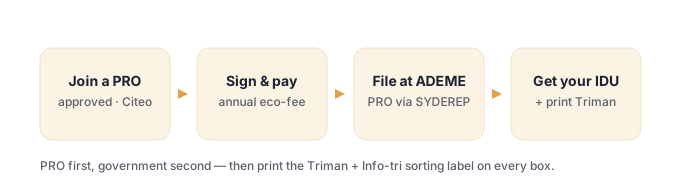
- PRO first, government second: Unlike Germany, you do not register directly with the government first. You must join a Producer Responsibility Organisation (PRO) like Citeo, which then secures your registration number.
- The all-important IDU: Your Identifiant Unique (IDU) is your golden ticket to sell in France. Marketplaces like Amazon will suspend your account if you cannot provide a valid IDU.
- Mandatory consumer labelling: You cannot ship blank, unlabelled boxes to France. Every piece of household packaging must feature the Triman logo and specific "Info-tri" sorting guidelines.
- The marketplace loophole: While Amazon can pay fees on your behalf for marketplace sales, you remain legally and financially liable for any direct-to-consumer sales generated through your own store (e.g., Shopify).
What is the AGEC Law and how does it affect EPR France?
Extended Producer Responsibility is a policy principle that forces the businesses generating packaging waste to pay for its eventual collection and recycling. In France, this principle was massively expanded and reinforced by the Loi Anti-Gaspillage pour une Économie Circulaire, commonly referred to as the AGEC law.
The AGEC law is a comprehensive anti-waste framework designed to transition France out of a linear "take-make-dispose" economy. For e-commerce sellers, the AGEC law dictates that you are an obligated producer if you import, pack, or distance-sell packaged goods to French households. The law strictly prohibits the destruction of unsold non-food products, enforces rigorous recycling targets, and manages compliance across over a dozen different waste streams (including packaging, textiles, batteries, and electronics).
If you sell across borders, you must understand that EPR by country in Europe is highly fragmented. What works in Sweden or Spain will not legally cover you in France.
How to get your IDU France (Identifiant Unique)
The most urgent task for any foreign seller entering the French market is securing an IDU France.
The Identifiant Unique is a unique, alphanumeric registration code issued by ADEME, the French Agency for Ecological Transition. ADEME manages the national SYDEREP reporting registry, which tracks the compliance of all producers placing waste-generating products onto the French market. Your IDU is your official proof of compliance; it is the exact EPR number that digital platforms demand to keep your listings active.
However, the process of obtaining this number is structurally different from EPR Germany. You cannot simply log into the SYDEREP portal and register yourself for free.
To get your IDU, you must follow a specific sequence:
- Choose an approved PRO: You must select a government-approved Producer Responsibility Organisation (eco-organisme) that manages the household packaging waste stream.
- Sign a contract: You affiliate your business with the PRO by signing a commercial contract and paying an annual fee.
- Automatic ADEME registration: Once your contract is finalized, the PRO acts on your behalf. They interface with the SYDEREP database and instruct ADEME to generate your IDU.
- Receive and display: Your PRO will send you your IDU. You must then upload this number to your marketplace portals (like Amazon or eBay) and ideally display it in the general terms and conditions on your own website.
Citeo registration and household packaging
Because you must affiliate with a PRO, you need to know who the major players are. In France, the dominant eco-organisme for household packaging is Citeo (alongside Léko and Adelphe).
When you complete a Citeo registration, you are legally transferring your physical waste management obligations to them in exchange for a financial contribution. Citeo uses the funds collected from producers to finance municipal sorting centers, recycling infrastructure, and public awareness campaigns across France.
How Citeo rates and reporting work
You must declare your packaging volumes to Citeo on an annual basis (or more frequently for high-volume enterprise sellers). Your financial contribution is determined by the total weight of your packaging, broken down by highly specific material fractions (e.g., clear PET plastic, cardboard, aluminium).
Citeo enforces a strict system of eco-modulation—a mechanism where your Citeo rates for household packaging are adjusted based on how environmentally friendly your materials are.
- The Bonus: If you use highly recyclable, mono-material packaging, or include high percentages of post-consumer recycled (PCR) content, you receive a financial bonus (a discount on your fees).
- The Malus: If you use hard-to-recycle materials, such as dark opaque plastics, multi-layer composite pouches, or packaging that disrupts the recycling sorting machines, you are hit with a severe financial penalty (a malus) that dramatically increases your cost per kilogram.
Struggling to calculate the exact weight and material fractions of your cross-border shipments? Gram turns your real e-commerce orders into filing-ready packaging reports tailored perfectly for the Citeo portal. Join the Gram pilot waitlist today.
The Triman label and Info-tri sorting instructions
The AGEC law places a heavy burden on consumer communication. In France, it is illegal to place household packaging on the market without giving the end consumer explicit instructions on how to dispose of it. This is achieved through the Triman label.
The Triman logo—a pictogram of a human figure surrounded by three arrows—signifies that the packaging is subject to sorting rules. However, printing the logo alone is no longer sufficient. It must be accompanied by Info-tri (sorting info).
The Info-tri guidelines require you to visually break down the components of your packaging (for example, "Box" and "Plastic Wrapper") and assign them to the correct color-coded recycling bin. In France, the yellow bin (bac jaune) is the universal destination for recyclable packaging, while the green bin (bac vert) is reserved for glass.
Key rules for Triman compliance:
- Mandatory display: The logo and the Info-tri must be printed directly on the packaging, or affixed via a sticker. You cannot simply put the instructions on your website and skip the physical box.
- Size and contrast: The markings must meet strict minimum size requirements to remain legible and must contrast sharply with the background color of your packaging.
- Multi-component packaging: If your product ships in a cardboard box filled with plastic void fill, your Info-tri must explicitly instruct the consumer to separate the plastic from the cardboard before placing both in the yellow bin.
If you fail to apply the Triman label correctly, French customs authorities and market surveillance agencies can halt your shipments, seize your goods, and issue heavy administrative fines.
The "deemed producer" rule (Marketplace loophole)
If you are a merchant dealing with Amazon EPR, you have likely encountered France's deemed producer France rule.
To combat rampant non-compliance from overseas sellers, the French government introduced marketplace liability laws. If a digital platform like Amazon, eBay, or Etsy facilitates a sale to a French consumer, the platform itself is held legally responsible if the third-party seller fails to pay their environmental fees.
To protect themselves, platforms require you to input your IDU. If you cannot provide one, marketplaces will often invoke the "deemed producer" (or "Pay on Behalf") mechanism. Under this system, the marketplace automatically calculates your estimated packaging volumes, pays the eco-contributions to a PRO on your behalf, and forcibly deducts the costs from your seller account disbursements.
Why you should still register independently: While the Pay on Behalf system seems convenient, relying on it is a dangerous long-term strategy for growing brands:
- Administrative premiums: Marketplaces frequently charge significant handling fees on top of the base Citeo recycling tariffs.
- It only covers platform sales: The deemed producer rule only applies to the sales you make directly on that specific marketplace. If you run an independent storefront (such as a Shopify or WooCommerce site) and ship directly to French buyers, the marketplace is not covering you. You remain entirely liable to hold your own IDU and declare those direct-to-consumer volumes yourself.
How does PPWR 2026 impact French EPR?
While navigating the AGEC law and the Triman label is highly complex today, the regulatory landscape is about to undergo a massive continental shift. The new EU Packaging and Packaging Waste Regulation (PPWR) will become directly applicable across all 27 Member States on 12 August 2026.
Because the PPWR is a directly binding regulation, it overrides conflicting national laws. Crucially, the PPWR aims to harmonise consumer sorting instructions across the entire European Union. The regulation dictates that by 12 August 2028, all packaging must be marked with a newly designed, harmonised EU label to facilitate consumer sorting.
This means that the uniquely French Triman label will eventually be phased out and replaced by a standardized European pictogram. Member states will not be allowed to enforce national sorting labels that conflict with or duplicate the new EU-wide harmonized labels.
However, the financial obligations of EPR France will not disappear. Even under the new PPWR regime, you will still be legally required to affiliate with a local PRO like Citeo, maintain an active IDU registration on the SYDEREP portal, and pay eco-modulated fees based on the exact weight of the packaging you ship into French territory.
FAQ
What is an IDU number in France? The Identifiant Unique (IDU) is your official EPR registration number in France. It is issued by the national environmental authority (ADEME) through the SYDEREP portal once you have successfully affiliated with an approved Producer Responsibility Organisation.
How do I register for Citeo? You must sign a commercial contract with Citeo, the primary French PRO for household packaging. They will evaluate your packaging volumes, charge you an annual eco-contribution, and automatically register your business with ADEME to generate your IDU.
What is the Triman label? The Triman logo is a mandatory, consumer-facing sorting label required on all household packaging sold in France. It must be printed alongside 'Info-tri' instructions that clearly tell the buyer exactly which recycling bin the packaging belongs in.
What is the deemed producer rule in France? Under the AGEC law, marketplaces like Amazon can act as a 'deemed producer' and pay packaging fees on behalf of third-party sellers. However, this only covers sales made on their platform; you are still entirely liable for sales made through your own independent storefront.
Stop losing days to complex, per-country spreadsheets. Gram automatically maps your orders to the exact material fractions and eco-modulation rules required by Citeo and ADEME. Join the Gram pilot waitlist today.
Sources:
- Citeo - Membership and Registration
- Citeo - Rates for Household Packaging and Paper
- Citeo - Info-tri Sorting Guidelines
- ADEME - SYDEREP National Registry
- Service-Public - SYDEREP Reporting System
- Légifrance - Article L541-10 of the Environmental Code
- EUR-Lex - Packaging and Packaging Waste Regulation (EU) 2025/40
- Ecosistant - EPR Authorized Representative Guide