EPR by Country: EU Packaging Compliance Guide
EPR rules differ in every EU country. A country-by-country guide to packaging registration, PROs, and reporting — Sweden, Germany, France and more.
EPR by Country: Packaging Compliance Across the EU
Selling cross-border in Europe is fantastic for growth, until you hit the wall of packaging regulations. If your e-commerce store ships physical goods to multiple European nations, you must navigate a fragmented and deeply confusing web of environmental laws. EPR compliance Europe is not a single checkbox you can tick for the whole continent. Because of how the laws were written, EPR by country Europe means navigating 27 different sets of rules, portals, and fee structures.
Whether you are shipping from Sweden to Germany, or the US to France, you are legally responsible for the end-of-life recycling of your packaging in the destination country. This comprehensive guide breaks down the specific packaging EPR EU countries requirements for major markets, explaining where to register, which Producer Responsibility Organisations (PROs) to join, and what data you must report to keep your business fully compliant.
Key Takeaways:
- No central EU portal: You must register, report, and pay fees separately in every individual country where you sell to end consumers.
- Zero thresholds: Major markets like Germany and France have a zero-kilogram threshold. The obligation starts from your very first package.
- Penalties are severe: Failing to register leads to massive administrative fines, retroactive fee charges, and immediate delisting from marketplaces like Amazon.
- PPWR brings changes: The new 2026 EU packaging regulation will harmonise design rules and reporting formats, but the financial obligations will remain fiercely local.
Why is EPR different in every EU country?
To understand the chaos, you must look at the legal framework. Historically, Extended Producer Responsibility (EPR) for packaging was rolled out across the continent via the EU Waste Framework Directive 2008/98/EC.
A "directive" dictates a high-level environmental goal but leaves the actual implementation and enforcement up to the individual member states. As a result, each of the 27 EU nations transposed the rules into their own national laws differently. They established their own national registers, appointed different private PROs to collect the fees, and set wildly different reporting cadences (monthly, quarterly, or annually). For an e-commerce merchant, this means there is no central mechanism for paying your packaging fees. If you sell in five countries, you must register, track your packaging data, and pay fees in five separate national systems.
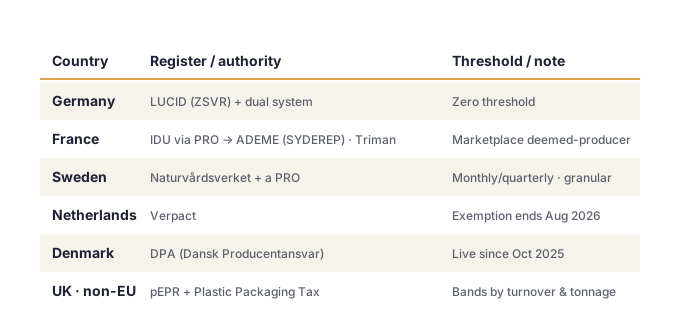
Below is a detailed breakdown of the obligations in the most critical European e-commerce markets.
EPR Germany: LUCID and the Dual System
Germany represents the largest e-commerce market in the EU, and it possesses the strictest, most heavily enforced packaging law, known as the VerpackG (Packaging Act). EPR Germany compliance is non-negotiable if you want to sell to German households.
- The Register: You must register directly with the government body, the Central Agency Packaging Register (ZSVR), via the LUCID packaging register web portal.
- The Threshold: Germany enforces a strict zero-kilogram threshold. You must hold a valid LUCID number before you ship your first cardboard box, plastic mailer, or roll of tape across the German border.
- The PRO System: Germany operates a unique "dual system." Getting a LUCID number is free, but you cannot stop there. You must then sign a commercial contract with a private dual system operator (such as Der Grüne Punkt, Interzero, or BellandVision). You pay this PRO based on your packaging weight, and you must report those exact same volumes back to the LUCID portal to ensure both datasets match perfectly.
- The Penalties: Germany actively and aggressively audits sellers. If you are caught selling without a LUCID registration, or if your reported data is incorrect, you face administrative fines of up to €200,000 per violation and complete market bans. Furthermore, Amazon and eBay will instantly suspend your listings if your LUCID number is missing or invalid.
EPR France: Citeo, the IDU, and Triman
France is equally strict but uses a structurally different approach governed by the AGEC anti-waste law. EPR France places a very heavy emphasis on consumer labelling and comprehensive end-of-life reporting.
- The Register and PRO: Unlike Germany, you generally do not register with the government first. Instead, you must affiliate with a state-approved PRO. Citeo is the primary organisation for household packaging. Once you affiliate with them, the PRO registers your business with the national environmental authority (ADEME) on the SYDEREP national reporting registry.
- The IDU: Upon successful registration, you receive your Identifiant Unique (IDU). This is your official proof of compliance and is the exact alphanumeric code Amazon, eBay, and other platforms demand to keep your listings active.
- The Triman Label: France mandates strict, consumer-facing sorting instructions. All household packaging must display the Triman Logo alongside specific sorting advice (Info-tri) that tells the buyer exactly which bin the packaging belongs in.
- Marketplace Exception vs. Direct Sales: While France introduced a "deemed producer" rule where marketplaces can pay fees on behalf of their third-party sellers, this only covers marketplace sales. If you also run an independent Shopify store and sell directly to French consumers, you remain entirely liable to register, report, and pay fees for those direct shipments.
Struggling to manage granular packaging data across Germany, France, and the rest of Europe? Manual spreadsheets cannot scale without massive error. Gram turns your real e-commerce orders into filing-ready packaging reports mapped to the exact requirements of each EU country. Join the Gram pilot waitlist today.
EPR Sweden: Naturvårdsverket, NPA, and TMR
In Sweden, the environmental protection agency oversees the system, and the reporting process requires high data granularity that catches many foreign merchants off guard.
- The Register: You must first register your business directly with the national authority, Naturvårdsverket (Swedish EPA).
- The PROs: After receiving your registration confirmation, you must affiliate with an approved PRO, such as Näringslivets Producentansvar (NPA) or TMR.
- Data Granularity (Privat vs. Annat): Swedish reporting is highly specific. When declaring to your PRO portal (which is typically done monthly or quarterly via manual kg-entry), you must divide your packaging into article numbers that specify the material, the recyclability tier, and whether the packaging is designed for household use (Privat bruk) or business use (Annat än privat bruk). Because hard-to-recycle red-tier plastics carry a massive fee premium compared to green-tier mono-materials, eco-modulation heavily dictates your costs in Sweden.
- Upcoming Changes: The Swedish system is rapidly maturing. By 1 January 2027, Swedish municipalities must offer property-close kerbside collection for packaging, which will increase recycling volumes and regulatory scrutiny on the producers funding the system.
EPR Netherlands: Verpact and the Threshold Change
The Netherlands is undergoing a significant and urgent transition regarding who must pay packaging fees, making it a critical market to watch.
- The Register and PRO: Packaging compliance is managed collectively by the central organisation Verpact (formerly Afvalfonds Verpakkingen).
- The Threshold Disappearance: Historically, the Netherlands offered a highly generous de minimis threshold—companies placing less than 50,000 kg of packaging on the market per year were exempt from paying the per-kilogram fee. However, due to new EU harmonisations, this 50,000 kg exemption for foreign distance sellers will disappear in August 2026.
- What this means for you: Small and medium-sized e-commerce brands shipping into the Netherlands will soon be financially liable from their very first package, mirroring the strict, zero-threshold environments of Germany and France.
EPR Denmark: The Newest Nordic Addition
Denmark was one of the last EU nations to fully implement financial extended producer responsibility for packaging, bringing its system online very recently.
- The Rollout: The Danish EPR packaging system officially went live in October 2025.
- The Obligations: Sellers must now register in the national DPA (Dansk Producentansvar) system and affiliate with a collective scheme. Like Sweden, the Danish system places a strong emphasis on detailed material breakdowns and will increasingly penalize unrecyclable packaging formats with colour-coded eco-modulation. If you sell into the Nordics, Denmark is no longer a free pass.
EPR in the UK: pEPR and the Plastic Tax
While no longer part of the EU, the United Kingdom remains a massive e-commerce market with its own complex, dual-layered packaging regulations.
- UK pEPR: The UK's overhauled packaging extended producer responsibility regulations split businesses into "Small" and "Large" producers. If your annual turnover is £1 million or more and you handle more than 25 tonnes of packaging, you must collect detailed data. If you exceed £2 million and 50 tonnes, you must pay full modulated recycling fees.
- Plastic Packaging Tax (PPT): Distinct from EPR fees, the UK also levies a Plastic Packaging Tax on plastic packaging manufactured in, or imported into, the UK that contains less than 30% recycled plastic.
How the 2026 PPWR Affects Country-Level EPR
While navigating 27 different EPR schemes is a logistical nightmare today, a major legal shift is imminent. The new Packaging and Packaging Waste Regulation (PPWR), Regulation (EU) 2025/40, takes general effect on 12 August 2026.
Because the PPWR is a regulation rather than a directive, its rules on packaging design, void-fill minimisation, and recyclability grades (A/B/C) will apply identically across the entire European Union.
However, it is crucial to understand that PPWR does not replace national EPR. You will still be required to register, report, and pay fees in every individual country. What changes is that PPWR mandates harmonised reporting formats and requires that all national PROs tie your EPR fees directly to the new EU-wide recyclability grades by 2030. This means a highly recyclable, green-tier mailer will secure you lower fees in every European country simultaneously, while hard-to-recycle composite packaging will be financially penalized everywhere.
FAQ
Is there a single EU-wide EPR registration? No. Extended Producer Responsibility is managed on a national level. You must register, report, and pay packaging fees separately in every EU country where you sell and ship goods to end consumers.
What happens if I sell cross-border without registering? You risk severe penalties, including administrative fines (up to €200,000 in Germany), retroactive fee charges, and immediate delisting from major marketplaces like Amazon and eBay.
Will the new PPWR regulation centralize EPR? No. The Packaging and Packaging Waste Regulation (PPWR), applicable from 12 August 2026, harmonizes packaging design and reporting formats, but the obligation to register and pay fees remains fragmented per country.
Which EU countries have no minimum threshold for packaging EPR? Major markets like Germany and France have a zero-kilogram threshold. You must be registered and compliant before shipping your very first package to a customer in these countries.
Stop losing days to complex, per-country spreadsheets. Gram automatically maps your orders to the correct national requirements, tariffs, and recyclability tiers across the EU. Join the Gram pilot waitlist today.
Sources:
- EU Waste Framework Directive 2008/98/EC
- Regulation (EU) 2025/40 on packaging and packaging waste
- ZSVR LUCID registration process
- Citeo membership and reporting
- French ADEME SYDEREP registry
- Naturvårdsverket extended producer responsibility obligations
- NPA packaging fees
- Verpact packaging administration rules
- Verpact PPWR overview
- UK extended producer responsibility for packaging rules
- UK Plastic Packaging Tax background
- Danish EPA guidance on modulated fees