Who Must Register for EPR? Producer Rules Explained
If you ship physical goods to EU customers, you're probably a "producer" under EPR. Here's who must register, when, and what happens if you don't.
Who Counts as a "Producer" Under EPR?
If you sell physical products online, you might be asking yourself: who needs to register for EPR? The short answer is that almost every cross-border e-commerce merchant does. Under Extended Producer Responsibility laws, you do not have to operate a large factory to be classified as a "producer." If you ship a cardboard box or plastic mailer to a customer in the EU, you are legally responsible for financing its end-of-life recycling. Here is exactly how to determine your status and what obligations apply to your store.
The EPR producer definition
Many online retailers mistakenly believe that only the original manufacturer of a physical product is liable for environmental compliance. However, under the EU Waste Framework Directive 2008/98/EC on producer definitions, the EPR producer definition is much broader and focuses on the entity that first places the packaging onto a national market.
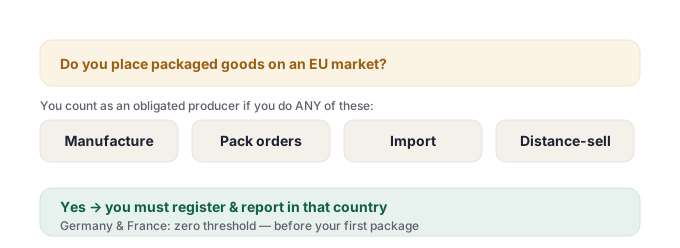
You generally count as an obligated producer if your business performs any of the following activities:
- Manufacturing: You manufacture and sell packaged goods under your own brand name.
- Packing: You place items into transit packaging (like mailers, boxes, and void fill) to fulfill customer orders.
- Importing: You bring packaged goods from outside a country into that national market for the first time.
- Distance Selling: You sell directly to end consumers in another country via an online storefront.
Because e-commerce inherently involves packing goods and shipping them to buyers, your store is almost certainly acting as an obligated producer. If you want to understand the overarching policy, read our comprehensive guide on What is EPR.
Importer packaging obligations vs. distance selling EPR
Your specific role dictates how you must register and report.
If you bring goods from outside the EU (or from another EU country) to sell to local retailers (B2B), you fall under importer packaging obligations. In this scenario, you are responsible for the packaging of the goods you import.
Conversely, if you run a Shopify store in Sweden and ship orders directly to consumers in Germany or France, you fall under distance selling EPR. Because you are introducing packaging directly to households in a foreign market, you must comply with the local EPR laws of the destination country, not just your home country. This means a Swedish brand shipping to Germany must register locally in Germany and pay German packaging fees.
Are you unsure if your cross-border sales trigger new obligations? Gram turns your real orders into a filing-ready EPR report mapped to the correct country. Join the pilot waitlist today.
Is there a de minimis threshold?
A common question among growing businesses is whether they can avoid registration if they only ship a small volume of orders. While it varies by country, relying on a de minimis threshold is a risky strategy.
- Zero Threshold Markets: In key markets like Germany and France, there is absolutely no minimum threshold. You must be registered and hold a valid EPR number before you ship your very first package across the border.
- Volume-Based Exemptions: A few countries do offer exemptions for micro-businesses. For example, under the UK's packaging regulations, you only face full financial reporting obligations if you surpass specific annual turnover and packaging weight thresholds.
Always assume you must register until you verify a specific country's exemption criteria, checking the detailed requirements for EPR in Sweden and other local markets before you sell.
What happens if I ignore the rules?
Failing to register as a producer is a direct violation of environmental law. The authorities are actively enforcing these rules, and the consequences for non-compliance are severe:
- Marketplace Delisting: The most immediate threat comes from online platforms. Due to marketplace liability laws, platforms enforce Amazon EPR requirements strictly. If you cannot provide a valid registration number, Amazon, eBay, and Etsy will suspend your listings and block you from selling in that country.
- Fines and Audits: National environmental agencies, such as the Swedish EPA Naturvårdsverket in Sweden and the the ZSVR's LUCID register in Germany, conduct active audits. Unregistered producers can face massive administrative fines (up to €200,000 in Germany) and be hit with retroactive charges for years of unpaid packaging fees.
- Market Bans: In extreme cases, repeated non-compliance can result in a complete legal ban on distributing your products within that national market.
Furthermore, with the new Packaging and Packaging Waste Regulation (EU) 2025/40 taking effect in August 2026, enforcement, data sharing, and labeling requirements will only become stricter across the entire European Union.
FAQ
Do I need to register for EPR if I sell via Amazon? Yes. Marketplaces like Amazon are legally required to verify your EPR registration. If you do not provide a valid EPR number, your listings will be suspended.
Is there a de minimis threshold for small sellers? In many major EU countries like Germany and France, there is no de minimis threshold. You must register from the very first package you ship.
What is the EPR producer definition? A producer is generally any business that first places packaged goods onto a national market, whether by manufacturing, importing, packing, or distance selling.
Stop doing your EPR reporting in spreadsheets. Gram turns your real ecommerce orders into filing-ready packaging reports for the whole EU. Join the Gram pilot waitlist today.
Sources: