EPR in Germany: LUCID, VerpackG & Dual Systems
Germany's VerpackG requires LUCID registration before your first sale. How to register, pick a dual system, and report packaging — with no threshold.
Packaging EPR in Germany: LUCID, VerpackG and Dual Systems
If you sell physical products to consumers in Germany, you are navigating the most strictly enforced packaging market in Europe. You have likely received urgent warnings from Amazon, eBay, or your logistics partner telling you to provide your LUCID registration. If you fail to comply, you face blocked sales, suspended listings, and massive regulatory fines.
Extended Producer Responsibility (EPR) in Germany is governed by the VerpackG (Packaging Act), which shifts the cost of recycling from municipalities directly onto the businesses generating the packaging. However, unlike many other European nations, the German system requires you to navigate a complex two-part process: registering with a government database and paying a private recycling company. This comprehensive guide breaks down exactly how to secure your LUCID number, choose a dual system, and file your reports without risking your market access.
Key Takeaways:
- Zero minimum threshold: Germany has no de minimis exemption. You must be fully registered and compliant before shipping your very first package.
- Dual reporting is mandatory: You must report your exact packaging weights twice—once to your commercial dual system, and once to the government’s LUCID portal. The data must match perfectly.
- Immediate marketplace delisting: Platforms like Amazon and eBay are legally forced to block your sales if they cannot electronically verify your active LUCID number.
- Severe financial penalties: Selling unregistered packaging can trigger administrative fines of up to €200,000 per violation and complete sales bans in Germany.
What is the VerpackG (German Packaging Act)?
The Verpackungsgesetz, commonly known as VerpackG, is the strict environmental law enforcing EPR in Germany. Its primary goal is to prevent packaging waste, increase recycling rates, and ensure that the companies placing packaging onto the German market pay for its eventual recovery.
Under the VerpackG, any business that introduces "system-participating packaging" to the German market for the first time on a commercial basis is classified as a producer. System-participating packaging simply means packaging that typically ends up as waste in a private household. If you are an international e-commerce brand packing items into a cardboard mailer and shipping them to a consumer in Berlin, you meet this definition perfectly.
To enforce this law, the government created an independent regulatory body called the Central Agency Packaging Register (ZSVR). The ZSVR monitors compliance, sets recyclability standards, and operates the mandatory public database known as LUCID. To see how the German legal framework compares to its Nordic neighbours, read our guide on EPR in Sweden.
Is there a minimum threshold for German EPR?
Many growing e-commerce sellers mistakenly assume they are too small to be noticed by foreign tax or environmental authorities. When it comes to packaging in Germany, this assumption is incredibly dangerous.
There is absolutely no minimum threshold for EPR registration in Germany. The legal obligation begins with the very first gram of packaging you place on the market. Whether you ship one small padded envelope a year or 100,000 heavy corrugated boxes, you must possess a valid EPR number before crossing the border.
How does the German Dual System work?
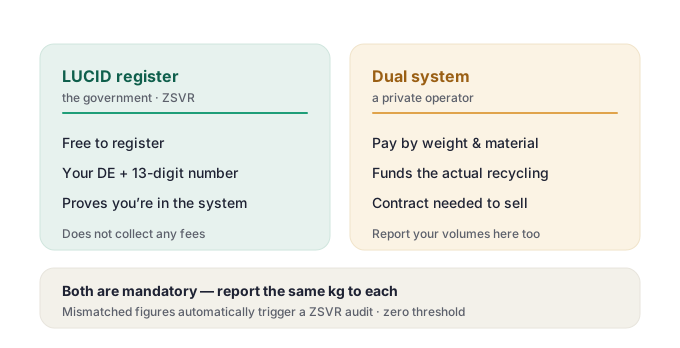
The most confusing aspect of German EPR for foreign sellers is the structural split between registration and payment. In Germany, getting a government registration number does not mean you have paid your fees. You must participate in the "dual system."
Here is how the two components work together:
1. The LUCID Register (The Government): LUCID is the public database run by the ZSVR. Registering your company here is completely free. This registration yields your unique LUCID number, which proves to the government (and to marketplaces) that you exist in their system. However, the ZSVR does not collect recycling fees or empty the physical bins on the streets.
2. The Dual System Operators (The Private Sector): To actually finance the collection, sorting, and recycling of your packaging, you must sign a commercial contract with a private company known as a "dual system." These are approved environmental service providers (such as Der Grüne Punkt, Interzero, or BellandVision). You pay this private operator a fee based entirely on the weight and material of the packaging you ship.
You cannot legally sell in Germany without having both an active LUCID registration and a paid contract with a dual system.
How to register for a LUCID number
Securing your compliance requires a specific sequence of actions. Because the systems cross-check each other, you must follow these steps in order before fulfilling German orders:
- Step 1: Create a LUCID account. Visit the LUCID packaging register web portal and create a login. You must provide your company details, VAT ID, and a declaration of the brands you intend to sell.
- Step 2: Receive your LUCID number. Upon completing the form, you will be immediately issued your unique registration number (which typically starts with "DE" followed by 13 digits).
- Step 3: Enter a Dual System contract. Choose an approved private dual system operator. When setting up your account with them, you must provide your new LUCID number. You will then purchase a "licence" by estimating how many kilograms of paper, plastic, and glass you plan to ship to Germany over the coming calendar year.
- Step 4: Report your initial volumes to LUCID. You must log back into the LUCID portal and enter the exact same estimated kilogram volumes you just submitted to your dual system operator. This is the crucial "data matching" step.
Are you overwhelmed by registering, tracking, and reporting data across Europe? Gram turns your real e-commerce orders into filing-ready packaging reports for Germany and beyond. Join the Gram pilot waitlist today.
How to report packaging data in Germany
Once you are registered, your administrative work is not over. Germany requires ongoing, meticulous data reporting.
The core rule of German EPR is dual reporting. Whenever you declare your packaging volumes, you must submit identical figures to both your private dual system and the government’s LUCID portal. If your dual system reports that you licensed 500 kg of paper, but your LUCID account shows 400 kg (or is blank), the ZSVR algorithms will automatically flag your company for an audit.
Intra-year and year-end reporting
Depending on your contract size, your dual system may require you to report your actual shipped weights monthly, quarterly, or annually.
Regardless of your intra-year cadence, every single seller must complete a final Year-End Volume Report (Jahresabschlussmeldung). Early in the new year, you must calculate the exact, final weight of all packaging shipped to Germany in the previous 12 months. You submit these final, reconciled figures to your dual system to settle your invoice, and then immediately submit the identical figures to LUCID.
You must break your data down by highly specific material fractions. You cannot simply report "boxes." You must separate your data into categories such as Paper/Cardboard, Plastics (for tape and mailers), Glass, Ferrous Metals, Aluminium, and Beverage Cartons.
What is the Declaration of Completeness (Vollständigkeitserklärung)?
For the vast majority of small and medium e-commerce sellers, the standard year-end volume report is sufficient. However, if you sell very high volumes of goods into Germany, you trigger an advanced auditing requirement known as the Declaration of Completeness.
You are legally required to submit a Declaration of Completeness if your annual German packaging volumes exceed any of the following heavy packaging thresholds:
- 80,000 kg of glass packaging.
- 50,000 kg of paper, paperboard, or cardboard packaging.
- 30,000 kg of plastics, aluminium, ferrous metals, and composite packaging combined.
If you cross these lines, you cannot simply submit your numbers online. Your packaging data must be formally audited and digitally signed by a registered auditor or certified tax advisor before being filed in the LUCID portal by May 15th each year.
Marketplace enforcement: Amazon and eBay rules
If you think you can fly under the radar, you must understand how marketplace liability works in Germany. In July 2022, the German government amended the VerpackG to make electronic marketplaces legally liable for the non-compliance of their third-party sellers.
Because Amazon, eBay, and Etsy do not want to pay your fines of up to €200,000 per violation, they aggressively enforce the rules.
If you use EPR for Amazon sellers, you must input your valid LUCID number into your Seller Central account. Amazon automatically pings the ZSVR database to verify that your number is active and matches your tax identity. If you cannot provide a verified number, your listings will be instantly blocked from view for any customer with a German shipping address. You cannot bypass this technological roadblock.
The risk of the public register
The LUCID database is entirely public. Anyone with an internet connection can search for a company name or brand to see if they are registered for packaging compliance.
This transparency was engineered deliberately by the German authorities to crowdsource enforcement. Competitors actively search the LUCID database for rival brands. If a competitor notices that you are actively selling in Germany but your brand is missing from the public register, they can (and often do) report you to the ZSVR or issue costly legal cease-and-desist letters for anti-competitive behaviour. Compliance is not just about avoiding government audits; it is about protecting yourself from aggressive commercial rivals.
How the new PPWR impacts German packaging compliance
While navigating the dual system is demanding today, a major legal shift is approaching. The new Packaging and Packaging Waste Regulation (PPWR) will become generally applicable across the European Union on 12 August 2026.
Because the PPWR is a directly binding regulation, it will harmonize packaging design rules, void-fill limits, and recyclability standards across all member states. However, it will not replace the German VerpackG or the LUCID system. You will still be required to maintain your dual system contracts and file your volume reports. For a broader view of how these fragmented local rules coexist across the continent, read our comprehensive guide to EPR by country in Europe.
Crucially, the PPWR will mandate that your German dual system fees become strictly eco-modulated based on new EU recyclability grades. This means that if you use highly recyclable mono-materials, your German recycling fees will decrease, whereas hard-to-recycle composite plastics will be hit with steep financial penalties.
FAQ
What is a LUCID number? A LUCID number is the unique EPR registration code issued to producers by the German Central Agency Packaging Register (ZSVR). You must obtain this number before shipping any packaged goods to German consumers.
Is there a minimum threshold for German packaging EPR? No. Germany enforces a strict zero-kilogram threshold. Your obligations begin from the very first shipping box or product packaging you send to a German household.
What is the German dual system? While LUCID is the free government registry, a dual system is a private commercial company (like Der Grüne Punkt or Interzero) that you must pay to physically collect and recycle your packaging waste based on the material weight you ship.
What is the Declaration of Completeness in Germany? The Vollständigkeitserklärung is an annual audited report required only for high-volume sellers who place over 80,000 kg of glass, 50,000 kg of paper, or 30,000 kg of plastics/metals on the German market.
Stop losing days to complex, dual-reporting spreadsheets. Gram automatically maps your orders to the exact material fractions required by LUCID and your German dual system. Join the Gram pilot waitlist today.
Sources: