EPR in Sweden: NPA, TMR & How to Report Packaging
How packaging EPR works in Sweden: register with Naturvårdsverket, affiliate with NPA or TMR, and report kg per material and recyclability tier.

Packaging EPR in Sweden: NPA, TMR and How to Report
Expanding your e-commerce store into the Nordic market is a highly lucrative move, but it comes with rigorous environmental obligations. If you ship packaged goods to Swedish customers, you fall under the scope of EPR Sweden.
Unlike other European markets that might only ask for broad material weights, the Swedish Extended Producer Responsibility system demands extreme data granularity. You are required to classify your packaging by specific material tiers, determine its exact recyclability, and decide whether it counts as household or commercial waste. Doing this manually for thousands of orders can quickly become an operational nightmare.
This comprehensive guide explains exactly how to navigate the Swedish regulations, whether you should choose NPA or TMR, and how to decode the complex reporting requirements without getting buried in spreadsheets.
Key Takeaways:
- Dual Registration: You must register with the government authority (Naturvårdsverket) and then affiliate with a Producer Responsibility Organisation (PRO) like NPA or TMR.
- Manual Portal Entry: Standard reporting is not automated. You must manually key your packaging weights into the PRO portal on a monthly or quarterly basis.
- Eco-Modulation: Fees vary wildly based on recyclability. Hard-to-recycle red-tier plastics cost approximately 65% more than highly recyclable green-tier plastics.
- Size Dictates Category: Whether packaging is classified as household (Privat bruk) or commercial (Annat än privat bruk) is determined strictly by its physical design and size, not by the buyer.
What is the Swedish EPR system and who oversees it?
In Sweden, Extended Producer Responsibility makes businesses financially and operationally responsible for the collection and recycling of their packaging waste. If you pack goods into boxes, import packaged products, or distance-sell physical items directly to Swedish consumers from abroad, you are legally an obligated producer.
The system is overseen by the Swedish Environmental Protection Agency, known as Naturvårdsverket. They are the central regulatory body enforcing the producer responsibility regulations.
To comply, your very first step must be registering your company directly with Naturvårdsverket. Once this is completed, you will receive a confirmation that allows you to move to the second step: contracting a PRO to handle the physical recycling and financial administration on your behalf.
Should I choose NPA or TMR for packaging compliance?
You cannot pay your packaging fees directly to the government. Instead, you must affiliate with a private, state-approved Producer Responsibility Organisation (PRO). In Sweden, the market is primarily served by two major PROs:
- NPA (Näringslivets Producentansvar): Formerly known as FTI, NPA is the largest and most established PRO in Sweden. They represent the vast majority of packaging producers and offer a robust, highly structured reporting portal.
- TMR (Tailor-Made Responsibility): TMR is a competing approved PRO that also offers comprehensive compliance services and recycling coordination for producers selling into the Swedish market.
Both organisations fulfill your legal obligation. Your choice will generally depend on their specific fee structures and the ease of use of their respective reporting systems. Whichever PRO you choose, you will be required to declare your packaging volumes to them on a regular schedule—usually quarterly for smaller merchants or monthly for high-volume enterprise sellers.
Are you struggling to keep up with the different PRO portals across Europe? Read our comprehensive overview on EPR by country in Europe to see how Sweden fits into your broader compliance strategy.
How does NPA reporting work in practice?
The most common point of failure for foreign e-commerce sellers is the reporting format. Many brands assume they can simply export a CSV file from their store and upload it to the Swedish authorities.
In reality, the NPA reporting system requires manual data entry. The portal is not designed for automated, system-to-system API uploads for ordinary small-to-medium businesses. When you log into portal.npa.se, you are presented with a series of empty fields. You must manually type in your total kilograms shipped, broken down by highly specific "article numbers."
These article numbers are not your product SKUs. They are unique Swedish compliance codes that encode three distinct pieces of information:
- The base material (e.g., paper, plastic, glass).
- The recyclability tier (e.g., green, yellow, or red).
- The usage category (household vs. business).
If you do not have software calculating these precise kilogram totals before you log in, you will be forced to manually weigh packaging and cross-reference NPA tariff tables for every single EU order you fulfill.
Stop losing days to manual data entry. Gram turns your real e-commerce orders into the exact kilogram numbers you need to copy and paste into the NPA portal. Join the Gram pilot waitlist today.
Privat vs Annat: How do I classify my packaging?
One of the most heavily scrutinized areas of Swedish EPR is distinguishing between household packaging (Privat bruk) and commercial packaging (Annat än privat bruk). Because commercial packaging generally carries drastically lower fees, merchants are often tempted to classify B2B shipments as Annat.
Under Swedish law, this is incorrect and can trigger audit penalties. Naturvårdsverket dictates a strict size and design test, rather than looking at the end customer.
- Privat bruk (Household): Packaging is classified as household if its physical size and design mean a normal consumer could plausibly acquire and dispose of it. For example, a 1-litre milk carton or a standard corrugated e-commerce shipping box is always Privat, even if you ship it directly to a restaurant or an office building.
- Annat än privat bruk (Business): Packaging is only classified as commercial if it is exclusively designed for industrial or bulk use. A 10-litre industrial milk container or a heavy-duty wooden shipping pallet would classify as Annat.
For the vast majority of direct-to-consumer (DTC) and standard B2B e-commerce brands, your shipping boxes, padded mailers, and void fill will strictly classify as Privat bruk.
How do article numbers and eco-modulation affect my fees?
Sweden uses a highly advanced system of eco-modulation. This means your packaging fees are directly tied to how easily your materials can be recycled.
When you report in the NPA portal, you must select the correct article number for your material's performance tier:
- Paper 3110 (Green Tier): Highly recyclable corrugated boxes or mono-material paper mailers.
- Plastic 4110 (Green Tier): Highly recyclable, clear mono-material plastics (like pure PE foils).
- Plastic 4150 (Red Tier): Hard-to-recycle plastics, heavily dyed materials, or complex multi-layer plastics that disrupt recycling infrastructure.
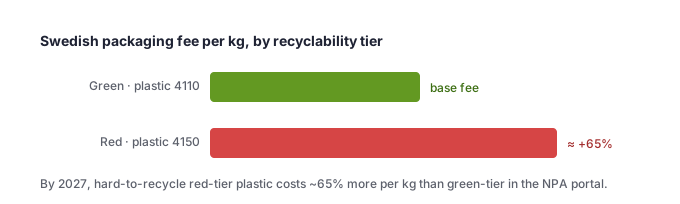
The financial impact of these tiers is massive. By 2027, reporting red-tier plastic (Article 4150) will cost you approximately 65% more per kilogram than highly recyclable green-tier plastic (Article 4110). If you fail to separate your green plastic from your red plastic in your reporting, you will either vastly overpay on your compliance bills or under-report and risk severe fines.
How do I report composite and multi-material packaging?
E-commerce packaging frequently mixes materials—think of a paper mailer lined with plastic bubble wrap, or a cardboard box sealed with heavy plastic tape. The Swedish system has very specific, and sometimes conflicting, rules for how to handle these composite items.
1. The Majority Material Rule (For PRO Fees): When paying your standard financial fees to your PRO (like NPA), if the materials cannot be easily separated by the consumer, you must report the entire weight of the packaging under its majority material. For example, if an inseparable padded mailer is 70% paper and 30% plastic, you report 100% of its weight as paper.
2. The Paper <5% Rule (For Eco-Modulation): There is a strict secondary rule for securing the cheaper green tier. A paper package only qualifies for the green tier (Article 3110) if less than 5% of its total mass consists of non-paper barrier materials (like a plastic window or laminate). If the plastic exceeds 5%, the entire package is downgraded to the expensive red tier (Article 3150).
3. The Annual EPA Report (Full Breakdown): To make matters more complex, the Swedish Environmental Protection Agency requires a separate, annual data report. For this specific report to Naturvårdsverket, you cannot use the majority rule. You must break down that same padded mailer into its exact constituent parts (e.g., reporting the exact grams of paper and the exact grams of plastic separately).
Without specialized EPR reporting software to automatically map these conflicting rules, maintaining compliance in Sweden requires immense manual administrative work.
What is changing in Sweden in 2027?
The Swedish EPR landscape is tightening. Starting on 1 January 2027, a major operational shift will occur. All Swedish municipalities will be legally required to offer property-close collection (kerbside collection) for paper, plastic, glass, and metal packaging.
This infrastructure upgrade is designed to radically increase consumer recycling rates. As collection volumes rise, the financial burden on the PROs—and consequently, the EPR fees charged to producers—will likely increase. This upcoming change signals that the authorities are taking packaging waste more seriously than ever, and enforcement audits against unregistered free-riders will only become more aggressive.
FAQ
How do I register for packaging EPR in Sweden? First, you must register your business directly with the Swedish Environmental Protection Agency (Naturvårdsverket). Once registered, you must sign a contract with an approved Producer Responsibility Organisation (PRO) such as NPA or TMR to handle your recycling fees and reporting.
What is the difference between Privat and Annat packaging? In Sweden, packaging is classified by its size and design, not by the customer who buys it. 'Privat bruk' (household) is packaging designed so that a normal household could plausibly use it. 'Annat än privat bruk' (business) applies to large-format or bulk packaging strictly designed for industrial use.
How are composite materials reported in Sweden? For your standard PRO fees (like to NPA), inseparable multi-material packaging is reported entirely under its majority material by weight. However, for your annual report directly to Naturvårdsverket, you must break down the exact weights of each separate material component.
Can I automate my NPA reporting via API? Currently, the standard NPA reporting portal requires manual kilogram entry per article number. There is no self-serve system-to-system API for ordinary merchants, which makes accurate data preparation critical before you log in.
Stop doing your Swedish EPR reporting in spreadsheets. Gram turns your real ecommerce orders into the exact article numbers required by the NPA portal. Join the Gram pilot waitlist today.
Sources:
Updated