EPR for Amazon Sellers: 2026 Rules & Delisting
Amazon delists sellers without an EPR number in Germany and France — and from Aug 2026, in every EU country you sell to. Here's how to stay listed.
EPR for Amazon Sellers: What You Must Do Before August 2026
Selling on Amazon in Europe comes with strict environmental rules. If you have received urgent warnings in Seller Central about EPR for Amazon sellers, you cannot afford to ignore them. Extended Producer Responsibility (EPR) is an environmental law requiring you to financially support the European Commission's packaging waste targets. If you fail to comply, Amazon will immediately suspend your listings. This guide explains what you must do to secure your registration numbers, navigate the upcoming 2026 regulations, and keep your store active.
Amazon EPR compliance: Why you are getting warnings
For years, many cross-border sellers ignored European packaging laws. That changed when countries like France and Germany introduced strict marketplace liability laws enforced by the German ZSVR.
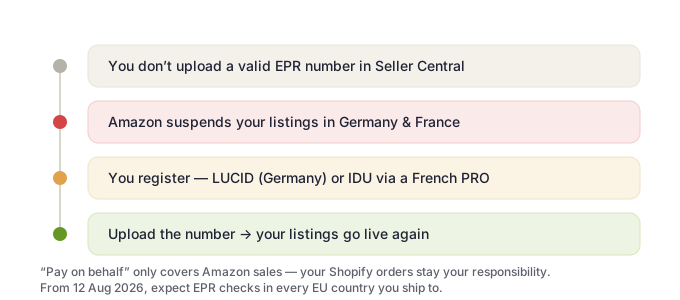
Under these rules, platforms like Amazon, eBay, and Etsy are held legally and financially responsible if their third-party sellers fail to comply with environmental regulations. To protect themselves from massive government fines, Amazon enforces these rules aggressively. They require you to upload a valid EPR number into your Seller Central account to prove you are registered with the local authorities.
The Amazon delisting EPR threat
If you sell physical goods to customers in the EU, the Amazon delisting EPR threat is immediate. The enforcement is currently strictest in two major markets:
- Germany: Germany has a zero-tolerance policy under the VerpackG law. You must secure a LUCID number from the national register before your very first sale. If Amazon cannot verify your LUCID number, your listings will be suppressed for German buyers.
- France: Under the French AGEC law, sellers must register for multiple waste streams, including packaging, textiles, and electronics. You must obtain an IDU (Identifiant Unique) and display the mandatory Triman sorting label.
Amazon "pay on behalf" vs. registering yourself
To prevent a massive drop in sales, Amazon introduced the Amazon pay on behalf system for certain countries, such as France and Spain.
Under specific conditions, if you do not provide your own EPR number, Amazon will automatically report your estimated packaging volumes, pay the eco-fees to the local authorities, and deduct the costs from your seller disbursements.
While this sounds convenient, relying on the "pay on behalf" or deemed-producer rule has significant drawbacks:
- Higher costs: Marketplaces often charge administrative premiums on top of the base recycling fees.
- Incomplete compliance: The pay on behalf service only covers your Amazon sales. If you are also shipping orders from your own independent Shopify store, you are still legally liable to register and report those sales separately.
Are you struggling to track your packaging data across Amazon, Shopify, and multiple EU countries? Gram turns your real e-commerce orders into filing-ready packaging reports in minutes. Join the pilot waitlist today.
Securing your LUCID number and Citeo Amazon France setup
To maintain full control of your business and costs, you should register your own EPR numbers and upload them to Seller Central.
- For Germany: You must create an account in the LUCID portal, receive your registration number, and enter it into Amazon. You must then pay a private recycling scheme (a Dual System) based on your packaging weight.
- For France: You cannot register directly with the government. You must first join an approved Producer Responsibility Organisation (PRO) like Citeo. Once you complete your Citeo Amazon France affiliation, Citeo will register you with the national authority (ADEME) and issue the IDU number you need for Seller Central.
The 2026 Rules: How PPWR impacts your Amazon store
While you must handle your national EPR registrations today, a massive regulatory shift is coming. The new EU Packaging and Packaging Waste Regulation (PPWR) will become applicable across all 27 Member States on 12 August 2026 under Regulation (EU) 2025/40.
The PPWR rules will dramatically reinforce marketplace compliance. By 2026, you can expect Amazon to require strict proof of compliance not just in Germany and France, but in every single EU country where you fulfill orders. Furthermore, by 2030, your EPR fees will be tied directly to new recyclability grades mandated by the PPWR. If your packaging is hard to recycle, your fees will skyrocket.
FAQ
What is Amazon EPR compliance? Amazon EPR compliance requires sellers to prove they are registered with national environmental authorities and are paying for the recycling of their packaging waste.
Will Amazon delist my products for EPR non-compliance? Yes. In countries like Germany and France, Amazon is legally required to suspend your listings and block sales if you do not provide a valid EPR registration number in Seller Central.
What is the Amazon pay on behalf model? In certain countries, Amazon may automatically pay your EPR fees to the authorities and charge the cost back to your seller account. However, registering your own numbers is often more cost-effective and essential if you sell on other platforms.
Stop doing your EPR reporting in spreadsheets. Gram turns your multi-channel orders from Amazon and Shopify into filing-ready packaging reports for the whole EU. Join the Gram pilot waitlist today.
Sources: