E-waste · Stiftung EAR
What is the stiftung ear and how do I register for WEEE in Germany?
A guide to the national register for electrical and electronic equipment in Germany
The stiftung elektro-altgeräte register (stiftung ear) is the German national clearing house and regulatory authority for electronic waste. It manages the mandatory registration of producers placing electrical equipment on the market and coordinates the municipal collection of discarded devices.
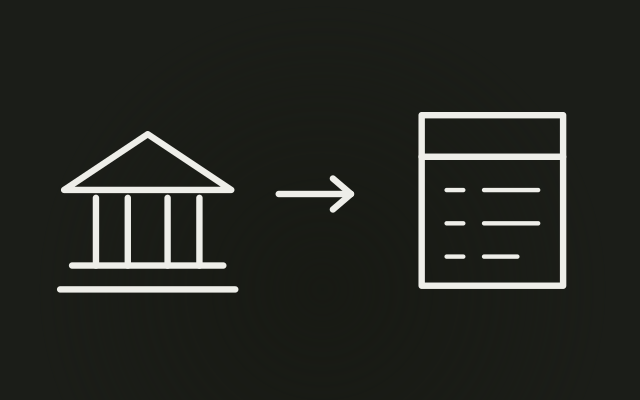
If your business manufactures, imports, or sells electronic devices to customers in Germany, environmental laws require you to finance the end-of-life recycling of those products. However, you cannot simply pay a commercial recycling scheme and ignore the federal government. Germany operates a highly regulated administrative framework to track exactly who is introducing electronics into the country, and the stiftung ear sits at the very centre of this system. It acts as the official registry under the German Electrical and Electronic Equipment Act (ElektroG), enforcing extended producer responsibility duties.
For international merchants and global brands, engaging with this registry is the ultimate prerequisite for maintaining market access. Online marketplaces and digital platforms are legally obligated to verify your compliance before allowing you to trade. If you attempt to ship battery-powered toys, computer monitors, or industrial servers into Germany without an active registration account at the stiftung ear, your listings will be suspended, and your logistics providers will refuse to process your inventory.
What the stiftung ear actually means
The stiftung ear is not a commercial waste management company or a physical recycling facility. It is an administrative body established by producers to execute sovereign tasks delegated to it by the German Federal Environment Agency. Its primary function is to maintain a comprehensive public database of compliant businesses, ensuring that no company can anonymously flood the market with cheap electronics while leaving the municipal taxpayer to fund the eventual recycling costs.
To trade legally, a business must open a digital account in the ear-portal and apply for a registration number. This application process demands highly specific details about the company, the products, and how the business intends to guarantee the financing of future waste collection. The registry scrutinises these applications to ensure that the financial guarantees are insolvency-proof and that the categorisation of the equipment is entirely accurate.
"Only those producers of electrical and electronic equipment registered with stiftung ear can enter a valid eight-digit WEEE-Reg.Nr."
This unique eight-digit sequence acts as your statutory licence to sell electronics in Germany. It proves to customs agents, environmental inspectors, and commercial distributors that your brand has accepted its legal and financial obligations. The stiftung ear strictly grants this registration per brand and per specific type of equipment. A producer will only have one overarching registration number, but they may hold several distinct registrations for different brands and equipment types under that single number.
Does this apply to me?
If you place electrical and electronic equipment on the German market for the first time, you must register with the stiftung ear. The legal definition of a producer is incredibly broad. It captures domestic manufacturers, independent online distance sellers operating from outside of Germany, and retailers who import finished, unbranded electronics from overseas factories to sell under their own store name.
The obligation is not restricted to household consumer goods. Registration is mandatory for both private (B2C) and professional (B2B) equipment. If you sell large-scale commercial devices that never enter a private home, you must still apply for registration through the ear-portal, provide prima facie evidence that the goods are not used in private households, and submit a detailed take-back concept explaining how you will recover the waste.
Furthermore, if you are a distributor or reseller, you carry severe secondary obligations. If you source electrical equipment from foreign manufacturers who are not registered with the stiftung ear, and who have not appointed an authorised representative, you legally become the producer and must apply for your own registration number for that equipment. German law strictly prohibits online marketplaces from enabling the sale of unregistered electronics, and it actively fines fulfilment service providers who warehouse, pack, or ship devices for unregistered brands.
Registration timelines, structure, and fees
Interacting with the stiftung ear involves navigating strict administrative timelines and complex fee structures dictated by German federal law. All processing is conducted digitally via the central ear-portal.
| Requirement or constraint | Regulatory detail |
|---|---|
| WEEE Registration Number | An 8-digit sequence issued upon successful registration. |
| Registration scope | Granted per producer, per brand, and per type of equipment. |
| Standard processing time | Normally takes 3 to 4 weeks for a complete and correct application. |
| Current processing delays | Due to high volume, examining and granting a registration currently takes around 8 weeks. |
| Administrative fees basis | Fees are charged according to the fee regulation on electrical and electronic equipment Act - batteries Act (ElektroBattGGebV). |
| Quarterly maintenance costs | Fees accrue for each started quarterly period and each valid registration number. |
Common misconceptions about the stiftung ear
I can register all my electronics under one single application. This is a frequent administrative error. Registration is never granted as a blanket licence for your whole company or for an entire product series. You must apply for registration for each specific brand and each specific type of equipment. If you are registered to sell large household appliances but later decide to sell small IT equipment under 50 cm, you must log into the portal and apply for a new registration for that new equipment type.
I do not have a trademark, so I cannot register. The stiftung ear does not require your brand to be a formally registered trademark in the sense of intellectual property law. If you do not have a designated brand name, you can simply use your company name as the brand. However, you cannot use generic terms to bypass the rules. Registration applications submitted under terms like 'no brand', 'no name', or simple equipment descriptions such as 'measuring device' or 'USB stick' are strictly inadmissible.
Once I hit submit in the portal, I am fully registered. Uploading your details to the ear-portal is only the first step. The stiftung ear acts as a sovereign authority and must thoroughly examine your application, your brand details, and your financial guarantees. You are not considered registered until the authority officially grants the registration and publishes your details in the public list of registered producers and authorised representatives.
Used equipment is exempt from registration rules. While reselling used equipment that was already legally placed on the German market by the original manufacturer does not require a new registration, importing used electronics is different. If you import used electrical equipment from abroad and introduce it to the German market for the first time, you must apply for your own registration number as the producer, or appoint an authorised representative if you are based outside the country.
5 examples of interacting with the stiftung ear
1. Creating an ear-portal account A new consumer electronics brand wants to launch its products in Europe. Before shipping any goods, the compliance manager logs into the stiftung ear's digital platform, sets up a user account, and inputs the company's legal entity details and payment information to begin the administrative process.
2. Submitting prima facie evidence for B2B goods An industrial machinery manufacturer applies to register their commercial control panels. During the application, they submit prima facie evidence to the stiftung ear proving that the equipment is strictly used in professional environments, alongside a formal take-back concept detailing how they will collect the panels at the end of their operational life.
3. Appointing an authorised representative A technology retailer based in the United States wants to sell directly to German consumers but lacks a physical branch in Europe. To comply with the law, the retailer appoints a German-based compliance agency as their authorised representative. The agency communicates directly with the stiftung ear and holds the registration on the retailer's behalf.
4. Verifying supplier compliance A domestic distributor wants to stock a new brand of Bluetooth speakers. Before signing the wholesale contract, the distributor searches the stiftung ear's public register to ensure the manufacturer holds a valid eight-digit registration number for the correct equipment type, thereby avoiding the risk of assuming the legal producer liability themselves.
5. Paying statutory fee invoices A registered importer of computer accessories receives an invoice from the stiftung ear. The invoice includes the mandatory quarterly maintenance fees calculated under fee-related matter 1.2 of the ElektroBattGGebV, ensuring the business maintains its active status on the public registry.
Terms related to the stiftung ear
| Term | What it means |
|---|---|
| Elektro- und Elektronikgerätegesetz (ElektroG) | The specific German federal law that mandates extended producer responsibility for electronics and empowers the stiftung ear. |
| Waste Electrical and Electronic Equipment Directive | The overarching European framework requiring the separate collection and recycling of discarded electronic devices. |
| Authorised representative | A legal entity located in Germany appointed by a foreign merchant to manage their registration and reporting duties with the stiftung ear. |
| Extended Producer Responsibility (EPR) | The policy principle requiring businesses to take financial and administrative ownership of the environmental impact of their products. |
Frequently asked questions
How long does it take to get a registration number?
The registration process involves a formal administrative review by the authorities. If you submit a complete and entirely correct application via the ear-portal, the procedure normally takes between 3 and 4 weeks. However, during periods of high application volume, the processing time can extend to around 8 weeks.
What is an eight-digit WEEE registration number?
When the stiftung ear successfully processes your application, they issue you a unique eight-digit registration number. This sequence serves as your legal proof of compliance. You must display this number on your commercial invoices and input it into the compliance portals of any digital marketplaces you use to sell your goods.
Do I have to pay fees for the registration?
Yes. The stiftung ear charges administrative fees based on the statutory fee regulation for electrical equipment and batteries, known as the ElektroBattGGebV. You will face initial application fees under fee-related matter 1.1 for each brand and equipment type, potential fees for examining B2B prima facie evidence under matter 1.7, and ongoing quarterly fees under matter 1.2 to maintain your active registration.
Can an online marketplace use my supplier's registration number?
Yes, if your supplier is the legally obligated producer who introduced the goods to Germany. If a marketplace demands an EPR number and you buy from registered companies, you should provide the marketplace with your supplier's registration number, as double reporting and unnecessary registrations for non-obligated companies must be absolutely avoided.
Why was my registration rejected for the brand name?
The stiftung ear strictly polices how brands are declared in the registry. You cannot use generic terms that fail to identify a specific economic operator. Applications using terms like 'no name', 'no brand', or generic product descriptions such as 'calculator' or 'measuring device' will be rejected as inadmissible. If you lack a formal trademark, you should use your official company name instead.
Sources:
Written by Daniel Vaknine, Co-founder – Compliance & Operations · Last reviewed 27 Jul 2026
Not sure what applies to you?
Answer a few questions about where you sell and see which packaging rules you fall under.
Check your obligations