E-waste · Waste Electrical and Electronic Equipment Directive 2012/19/EU
What is the Waste Electrical and Electronic Equipment (WEEE) Directive 2012/19/EU?
A guide to the European regulations governing the disposal and recycling of electronics
The Waste Electrical and Electronic Equipment (WEEE) Directive 2012/19/EU is the European legal framework that mandates the separate collection, treatment, and recovery of discarded electronics, shifting the financial burden of this waste management onto the businesses placing the items on the market.
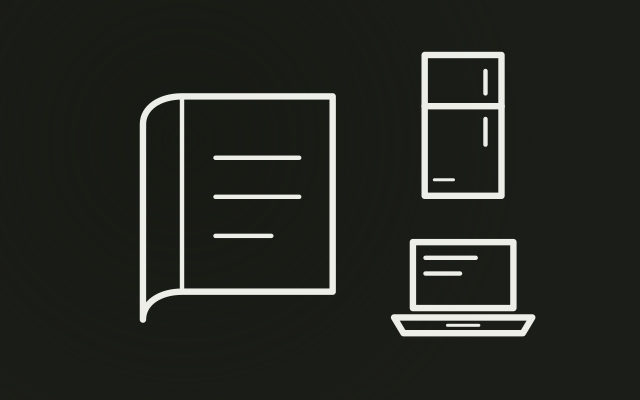
As electronic devices became cheaper and product lifecycles shortened, the volume of discarded electronics surged, creating one of the fastest-growing and most complex waste streams in the world. When laptops, kitchen appliances, and children's toys are thrown into standard household rubbish, the hazardous heavy metals and rare earth elements inside them are lost to landfills or incinerators, creating severe environmental and health risks. To combat this, regulators determined that the municipal taxpayer should not bear the cost of recycling highly engineered commercial products.
To address the crisis, European regulators introduced strict extended producer responsibility rules specifically for electrical goods. The directive ensures that any merchant manufacturing, importing, or distance selling electronics into a Member State is financially responsible for recovering those items when they reach the end of their useful life. For online sellers and cross-border brands, this means that before a single cable or computer can be sold, the business must register with national environmental agencies, declare their sales volumes, and pay to fund the municipal collection infrastructure.
What the WEEE Directive 2012/19/EU actually means
The directive is a recast of older European rules, specifically updating Directive 2002/96/EC to close loopholes, harmonise national registries, and significantly increase the mandatory recovery targets for Member States. It requires countries to establish infrastructure that prevents electronics from being disposed of as unsorted municipal waste, while demanding that all collected items undergo proper, environmentally sound treatment. This treatment must include, as a minimum, the removal of all fluids and the selective processing of specific hazardous components outlined in the legislation.
"'waste electrical and electronic equipment' or 'WEEE' means electrical or electronic equipment which is waste within the meaning of Article 3(1) of Directive 2008/98/EC, including all components, sub-assemblies and consumables which are part of the product at the time of discarding".
To fund this infrastructure, the directive assigns the legal obligation to the "producer". Under the legislation, a producer is any natural or legal person who manufactures, sells under their own brand, or imports electrical and electronic equipment on a professional basis into a Member State, irrespective of the selling technique used, including distance communication. This broad definition intentionally captures almost every node of the modern e-commerce supply chain. To alert consumers to these separate collection systems, the directive also mandates that producers appropriately mark all equipment placed on the market with a specific symbol depicting a crossed-out wheeled bin.
Does this apply to me?
If you sell physical products that rely on electrical currents or electromagnetic fields to work properly, you are highly likely to fall under the scope of this directive. Since 15 August 2018, the directive has operated under an "open scope", meaning it applies to all electrical and electronic equipment unless the item falls under a highly specific, narrow exemption, such as equipment designed to be sent into space or large-scale stationary industrial tools.
For cross-border sellers, the rules apply on a strictly national basis. If your company is headquartered in France but you distance sell electronics directly to private households in Germany or Spain, you act as the producer in those destination countries. You must register with the respective national authorities and finance the recovery of the waste generated by your sales in those specific markets. Because online marketplaces face severe joint liability risks regarding unregistered waste, they will actively verify your WEEE registration numbers and suspend your product listings if you fail to prove compliance.
Furthermore, the directive places an administrative burden on producers to inform the downstream waste industry. Brands launching new appliances must provide information to treatment facilities detailing exactly where dangerous substances and mixtures are located within the device, ensuring the recycling centres can dismantle the unit safely and legally.
WEEE recovery targets and deadlines
The directive sets out escalating targets for the recovery, recycling, and preparation for re-use of different categories of electronic waste. From 15 August 2018, all equipment is classified into six broad categories, each carrying specific statutory minimum recovery thresholds.
| Category or Requirement | Minimum target or deadline | Legal reference |
|---|---|---|
| Open scope application | All electrical and electronic equipment covered from 15 August 2018 | WEEE Directive Article 2(1)(b) |
| Category 1 or 4 targets | 85% recovered, and 80% prepared for re-use and recycled | WEEE Directive Annex V, Part 3 |
| Category 2 targets | 80% recovered, and 70% prepared for re-use and recycled | WEEE Directive Annex V, Part 3 |
| Category 5 or 6 targets | 75% recovered, and 55% prepared for re-use and recycled | WEEE Directive Annex V, Part 3 |
| Category 3 targets | 80% recycled | WEEE Directive Annex V, Part 3 |
| Market placement marking | Mark specifying the equipment was placed on the market after 13 August 2005 | WEEE Directive Article 15(2) |
Common misconceptions about the WEEE Directive
It only applies to items with a plug. This is incorrect. The directive covers equipment that is dependent on electric currents or electromagnetic fields in order to work properly. This means battery-powered devices, solar-powered garden lights, and items that only require a very small electrical current to perform a secondary function, such as a musical greeting card or a sports shoe with flashing lights, are fully regulated as electronic equipment.
One European registration covers my entire business. This is a frequent and costly mistake. The directive is a European framework, but it is transposed into national law by each individual Member State. There is no central, pan-European WEEE registry. If you sell electronic products into five different European countries, you must secure five distinct national registrations, appoint local representatives where required, and submit separate data reports to five different national compliance schemes.
My factory in Asia already paid the compliance fees. Under the directive, the legal responsibility rests with the entity that first places the equipment on the market in a specific European Member State. If you import finished electronics from a manufacturer outside of the European Union, you are legally classified as the producer in your domestic market. You cannot rely on an overseas factory to cover your statutory waste management bills.
Selling B2B equipment exempts me from the rules. While the collection mechanics for household goods differ from commercial equipment, business-to-business (B2B) electronics are still heavily regulated. If you sell industrial IT servers or commercial catering equipment, you remain obligated to register as a producer, report your sales data, and provide a financial mechanism to ensure the equipment is recovered when the commercial buyer discards it.
5 examples of falling under WEEE regulations
1. Selling smart home accessories A retailer imports wireless smart plugs and temperature sensors from an overseas supplier to sell domestically. Because these devices rely on electromagnetic fields to communicate and regulate power, the retailer must register as a producer and report the weight of the items placed on the market.
2. Distance selling small IT equipment An independent merchant based in Italy sells computer routers and keyboards through their own website to consumers in Spain. Under the open scope rules, these items fall into Category 6, requiring the merchant to register with the Spanish environmental authorities.
3. Marking products with the crossed-out wheeled bin A manufacturer designs a new range of electric toothbrushes. Before shipping the products to distributors, the manufacturer must ensure the devices are printed with the mandatory crossed-out wheeled bin symbol to inform consumers that the item must not be thrown in the general rubbish.
4. Providing information to treatment facilities A brand launching a novel electronic appliance publishes a technical manual specifically for waste treatment operators. This manual details exactly where the hazardous components and batteries are located within the device, ensuring the recycling facility can safely dismantle the unit in compliance with the directive.
5. Appointing an authorised representative A technology brand headquartered in the United Kingdom wishes to sell electronic tablets directly to consumers in Germany. Because the brand is established outside the European Union, it appoints a German authorised representative to handle its legal registration and data reporting with the national registry.
Terms related to the WEEE Directive 2012/19/EU
| Term | What it means |
|---|---|
| Extended Producer Responsibility (EPR) | The policy principle ensuring that businesses financially fund the end-of-life collection and recycling of the products they sell. |
| Elektro- und Elektronikgerätegesetz (ElektroG) | The specific national law that transposes the requirements of the European WEEE Directive into German legislation. |
| Stiftung ear | The national register in Germany where producers of electrical and electronic equipment must register to comply with the directive. |
| Authorised representative | A local legal entity appointed by a foreign producer to handle their environmental registration and reporting in a specific country. |
| Circular economy | An economic model designed to eliminate waste by keeping products, components, and materials in continuous use at their highest value. |
Frequently asked questions
What products are covered by the open scope?
Since 2018, the directive has applied to virtually all electrical and electronic equipment, classified into six broad categories. These include temperature exchange equipment, screens and monitors, lamps, large equipment, small equipment, and small IT and telecommunication equipment. If a product relies on electricity for its primary or secondary function, it is generally captured by these categories.
Do I have to pay to recycle the electronics myself?
No, it is generally physically impossible for a single brand to collect its own discarded devices from consumers across a whole country. Instead, the directive allows producers to join collective compliance schemes, commonly known as Producer Responsibility Organisations. You pay a financial contribution to these schemes based on your sales volumes, and the scheme uses the pooled funds to manage the physical collection and recycling networks on your behalf.
Are batteries covered by the WEEE Directive?
While the device itself is covered by the WEEE Directive, the batteries contained inside it are generally governed by a separate, dedicated European battery regulation. Merchants must usually complete two entirely distinct registrations: one reporting the weight of the electronic device without the battery, and a second registration reporting the precise weight and chemistry of the battery itself.
What is the crossed-out wheeled bin symbol?
It is the mandatory visual marking required by the directive for all electrical and electronic equipment placed on the market. It clearly signals to the end consumer that the product must be collected separately and not disposed of as unsorted municipal household waste. If the product is too small to carry the mark, it must be printed on the packaging, the instructions for use, and the warranty.
How do regulators know when an item was sold?
The directive requires producers to mark their equipment to specify that it was placed on the market after 13 August 2005. This helps waste treatment facilities determine exactly which financial mechanism is responsible for covering the cost of recycling that specific item, separating modern waste from historical waste placed on the market before the original regulations took effect.
Sources:
Written by Daniel Vaknine, Co-founder – Compliance & Operations · Last reviewed 27 Jul 2026
Not sure what applies to you?
Answer a few questions about where you sell and see which packaging rules you fall under.
Check your obligations