Materials · Mechanical Recycling Process
What is the mechanical recycling process for packaging?
A guide to how waste materials are physically reprocessed into secondary raw materials
The mechanical recycling process is the dominant method for managing post-consumer waste, involving the physical sorting, washing, shredding, and melting of discarded packaging to create secondary raw materials. It preserves the material structure without altering its core chemical composition.
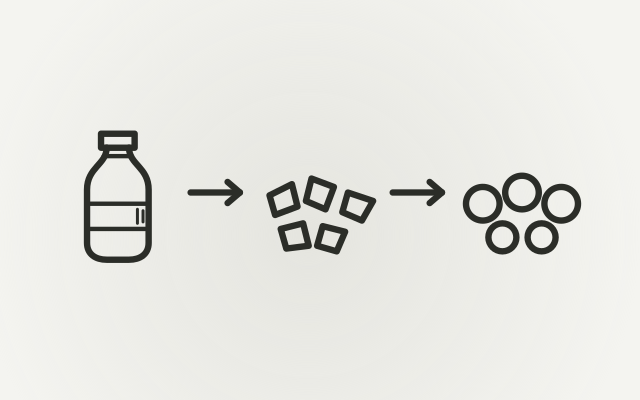
When a consumer discards a plastic bottle, an aluminium can, or a corrugated cardboard shipping box, that item begins a highly industrialised journey. Instead of being incinerated for energy or buried in a municipal landfill, packaging designed for circularity enters the mechanical recycling loop. This physical system breaks down the collected waste into clean flakes, pellets, or pulps, which are then sold back to manufacturers to be moulded into new consumer products. Because it requires significantly less energy than extracting and refining virgin fossil fuels or timber, it operates as the preferred environmental and economic pathway for managing household rubbish.
For packaging engineers, procurement teams, and cross-border merchants, understanding this physical process is an absolute operational necessity. Extended producer responsibility legislation actively penalises brands that use materials incompatible with these industrial systems. If your packaging features heavy black pigments, inseparable mixed plastics, or highly toxic adhesives, the optical sorters will reject it, and the material will be destroyed. Environmental regulators will then charge you a higher compliance tariff to cover the financial loss of that waste, making mechanical recyclability a direct driver of your commercial packaging costs.
What the mechanical recycling process actually means
In the context of environmental legislation, material recycling means any recovery operation by which waste materials are reprocessed into materials or substances, whether for the original or other purposes, with the exception of biological treatment of waste, reprocessing of organic material, energy recovery and reprocessing into materials that are to be used as fuels or for backfilling operations. In practice, this means the material is ground down, cleaned of external contaminants, and melted or reformed via physical forces, keeping the underlying polymer chains or chemical bonds entirely intact.
"Mechanical Recycling is currently the dominant recycling technique for post-consumer plastic packaging waste. Sorting and reprocessing technologies are available in most EU Member States with varying levels of recycling quotas."
However, the physical nature of this process creates inherent limitations. Every time a piece of plastic or paper goes through the shredding and melting phases, its technical characteristics degrade slightly. Because embedded energy and value are lost in the process, recycling is actually considered the last resort action in a pure circular economy. To combat this degradation and keep materials circulating in the economy for longer, European regulators are pushing heavily for high-quality recycling. This strictly defined standard requires any recycling process to produce recycled materials that are of equivalent quality to the original materials, based on preserved technical characteristics, so they can be used as a substitute to primary raw materials where the quality of the recycled material is retained.
Does this apply to me?
If you manufacture goods, import finished products, or select the protective packaging for consumer sales, the limitations of the mechanical recycling process apply directly to your supply chain decisions. Extended producer responsibility schemes dictate that the company placing the packaging on the market must physically and financially provide for its eventual end-of-life recovery. If you choose packaging designs that damage, confuse, or disrupt municipal recycling machinery, you carry the financial liability for that disruption.
You cannot simply print a universal recycling symbol on your boxes and assume the local waste facility can process them. You must verify that your specific material format is compatible with the physics of the sorting facility. For example, if you design rigid plastic components with densities above 1.09 grams per cubic centimetre or 1.12 grams per cubic centimetre, they are typically not recovered in industrial-scale recycling plants. Similarly, flexible plastic films and expanded foams, which are separated via automated suction systems, require highly specific handling parameters. If your packaging design prevents the mechanical machinery from identifying, isolating, and grinding the material cleanly, the authorities will classify your product as non-recyclable.
Recycling targets and performance grades
Authorities track the efficiency of mechanical recycling infrastructure and enforce strict statutory targets to ensure that household packaging is actually recovered at scale rather than simply collected.
| Metric or requirement | Detail |
|---|---|
| Material recycling definition | Physical reprocessing excluding biological treatment, energy recovery, and fuel conversion. |
| High-quality recycling definition | Produces recycled materials of equivalent quality to the original materials to substitute primary raw materials. |
| Packaging waste recycled at scale (Plastics) | Requires an annual quantity of recycled material equal to or greater than 55 per cent. |
| Recyclability performance Grade A | Assessed recyclability per packaging unit is higher or equal to 95 per cent. |
| Recyclability performance Grade C | Assessed recyclability per packaging unit is higher or equal to 70 per cent. |
Common misconceptions about the mechanical recycling process
Any plastic item can be mechanically recycled. This is a fundamental misunderstanding of waste infrastructure. While almost all polymers are technically capable of being melted down in a pristine laboratory environment, municipal mechanical recycling relies entirely on fast-moving optical sorting machines and density water baths. If your plastic uses carbon black pigment, the near-infrared optical sensors cannot see it on the conveyor belt, meaning the machinery treats it as unknown residue and sends it to be incinerated.
Mechanical recycling creates identical, brand-new plastic. Unlike chemical recycling, which reduces plastics to their base molecular monomers, mechanical recycling gradually shortens the polymer chains through physical stress and heat. This means that a clear plastic water bottle cannot be mechanically recycled into another clear plastic water bottle endlessly. The material degrades, turns cloudy, and typically must be blended with virgin plastic or downcycled into less demanding items like synthetic textiles or construction materials.
Biodegradable plastics help the mechanical process. Plastics marketed as compostable or biodegradable, such as polylactic acid (PLA), are actually severe contaminants in a standard mechanical recycling stream. If a consumer throws a PLA cup into a plastic recycling bin, it mixes with standard polyethylene terephthalate (PET). When the recycler melts the batch, the drastically different melting temperatures cause the entire silo of recycled plastic to become structurally unstable and commercially worthless.
Paper recycling can be repeated forever. While paper and corrugated cardboard have exceptionally high mechanical recovery rates, the repulping process relies on vigorous physical agitation in water. This churning action physically breaks and shortens the cellulose paper fibres every time the material is processed. After 5 to 7 cycles, the fibres become too short to bind together to form strong paper, requiring the continuous introduction of virgin wood pulp to maintain the structural integrity of the final recycled cardboard.
5 examples of mechanical recycling stages
1. Optical sorting and identification Near-infrared cameras scan the mixed waste as it travels on a fast-moving conveyor belt. The sensors identify the specific light reflection signature of different materials, instantly distinguishing high-density polyethylene from standard paperboard, and use targeted blasts of compressed air to blow the items into the correct processing bins.
2. Density separation in water baths Shredded plastic flakes are dumped into a large, agitated water bath. Because different plastics possess different inherent weights, heavy plastics like polyvinyl chloride sink to the bottom of the tank, while lighter plastics like polypropylene float to the top, allowing recyclers to separate the materials using simple physics.
3. Intensive hot washing To ensure the final secondary raw material is hygienic and safe for new manufacturing, the sorted material flakes undergo an intensive hot washing phase. The friction and high temperatures remove surface contaminants, organic food residue, and any paper labels or water-soluble glues that remained attached to the primary packaging.
4. Extrusion and pelletising Once the plastic material is clean and dry, it is fed into an industrial extruder where it is heated until it melts into a viscous liquid. The molten plastic is pushed through a steel die to create long, continuous strands, which are rapidly cooled in water and chopped by a rotary blade into uniform, easily transportable pellets.
5. Paper repulping and screening When corrugated board is mechanically recycled, it is mixed with large volumes of warm water and agitated in a massive steel vat called a pulper. This physical action breaks the cardboard back down into a thick slurry of loose cellulose fibres, allowing the facility to screen out staples, plastic tape, and grit before pressing the clean pulp into new paper sheets.
Terms related to the mechanical recycling process
| Term | What it means |
|---|---|
| post-consumer-recycled-pcr-plastic | Plastic material that has been used by a consumer, mechanically reprocessed, and turned into a raw material for new packaging. |
| material-recovery-facility-mrf | The highly industrialised sorting plant that separates mixed household waste into distinct, mechanically recyclable material streams. |
| mono-material-packaging | A packaging design that uses exclusively one type of material, making it highly compatible with physical recycling machinery. |
| biodegradable-plastics-pla-phb | Alternative plastics designed to decompose in specific environments, which act as dangerous contaminants if mixed into mechanical recycling vats. |
Frequently asked questions
What is the difference between mechanical and chemical recycling?
Mechanical recycling uses physical processes like grinding, washing, and melting to reshape materials without altering their underlying molecular structure. Chemical recycling uses advanced thermal or chemical processes to break the waste down at a molecular level, reducing polymers back into their original chemical building blocks, which can then be reconstructed to create virgin-quality plastics.
Why is it difficult to mechanically recycle flexible film?
Thin, flexible plastic films and mailing bags cause severe operational problems in physical sorting facilities. Because they are lightweight and lack rigidity, they easily tangle and wrap around the spinning gears, screens, and shafts of the sorting machinery. This forces the plant operators to halt the entire system frequently to manually cut the jammed plastic out of the equipment.
How does packaging design impact mechanical recyclability?
A package is only mechanically recyclable if the facility can easily isolate the core material. If a brand glues a large paper label to a plastic tub using a heavy, non-water-soluble adhesive, the recycling machinery cannot separate the two materials during the washing phase. The resulting melted plastic will be severely contaminated with burnt paper ash, rendering it useless for future manufacturing.
What does high-quality recycling achieve?
High-quality recycling is a strict regulatory standard that requires the mechanically processed material to retain enough technical integrity to act as a direct substitute for primary raw materials in demanding commercial applications. For example, turning a clear PET beverage bottle back into a food-grade, clear PET beverage bottle is a high-quality recycling outcome, whereas melting it down to create a single-use black rubbish bag is a lower-quality result.
Can mechanical facilities process multi-material packaging?
Generally, no. Mechanical facilities are designed to separate individual items, not to dismantle complex, fused composites. If your packaging permanently bonds a layer of aluminium to a layer of plastic and a layer of cardboard - such as in a standard crisp tube or a complex beverage carton - standard mechanical sorters cannot split the layers apart. These items either require highly specialised, expensive recycling streams or are simply rejected and incinerated.
Do extended producer responsibility schemes charge more for hard-to-recycle items?
Yes. Under strict eco-modulation rules, compliance schemes apply heavy financial penalties to packaging that disrupts the mechanical recycling process. If you use a material combination that a standard material recovery facility cannot easily sort, clean, and sell, your environmental tariffs will be significantly higher than a competitor using a clean, easily processed mono-material design.
Sources:
- Packaging and Packaging Waste Regulation (EU) 2025/40
- Fact sheets & background information – Page 2 – European Bioplastics e.V.
- Circular Economy Glossary - Ellen MacArthur Foundation
- Glossary of Terms | Circular Economy Definitions - Ellen MacArthur Foundation
- Automotive & EEE design for recycling Guidelines - RecyClass
Written by Anton Kröger, Co-founder – Engineering & AI · Last reviewed 27 Jul 2026
Not sure what applies to you?
Answer a few questions about where you sell and see which packaging rules you fall under.
Check your obligations