Materials · Material Recovery Facility (MRF)
What is a Material Recovery Facility (MRF) and how does it sort packaging?
A guide to the industrial sorting centres that dictate packaging recyclability
A Material Recovery Facility is a specialised industrial plant that receives, separates, and prepares mixed waste for recycling. It uses advanced mechanical and optical sorting technology to split municipal rubbish into distinct material streams that can be sold as secondary raw materials.
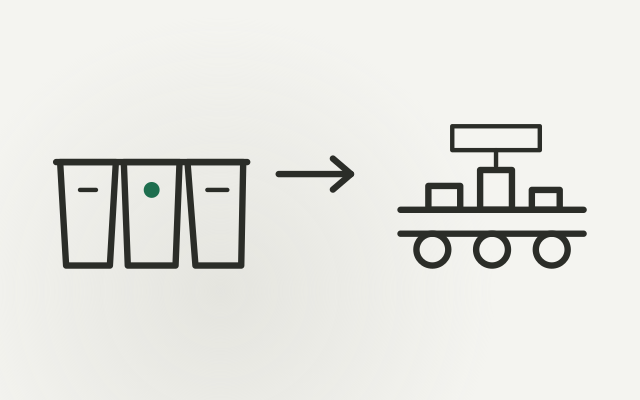
When a consumer places a corrugated cardboard box or a clear plastic bottle into their household recycling bin, the material does not travel directly to a manufacturer to be melted down or pulped. Instead, the mixed waste is collected by municipal or private haulage fleets and transported to a massive, centralised processing hub. These hubs act as the highly engineered gateway between consumer disposal and the actual chemical or mechanical recycling processes that turn old packaging into new products.
For e-commerce merchants and physical retailers, understanding how these facilities operate is no longer an optional sustainability exercise. Under modern environmental frameworks, packaging must be explicitly designed to navigate the complex, high-speed machinery within these sorting centres. If a package is too small, too structurally complex, or uses incompatible materials that confuse optical scanners, the facility will reject it as residue. This rejected material is typically incinerated, directly increasing the brand's extended producer responsibility fees and risking outright market bans.
What Material Recovery Facility (MRF) actually means
At a technical level, a Material Recovery Facility (MRF) relies on a sequential combination of gravity, magnetism, air currents, and optical sensors to separate comingled waste at immense speed. Conveyor belts carry thousands of tonnes of material through rotating trommels and ballistic separators, which use physical vibration to divide rigid, three-dimensional objects like glass bottles from flexible, two-dimensional items like plastic films. Further down the line, eddy currents and metal detectors are deployed to eject aluminium and steel formats. For plastics, near infra-red scanners read the specific polymer signatures of passing items and trigger targeted air jets to blow them into the correct holding bunkers.
European packaging legislation explicitly ties the legal definition of recyclability to whether a packaging unit can successfully pass through this exact infrastructure. A material is only considered recyclable if the waste management system can physically sort it into a defined, high-quality stream in the real world, rather than just in a controlled laboratory test.
"‘Recyclability’ means the compatibility of packaging with the management and processing of waste by design, based on separate collection, sorting in separate streams, recycling at scale and the use of recycled materials to replace primary raw materials."
If a facility is not equipped to recover specific features, such as foams and films which require distinct suction systems, or polymers with high densities, the packaging will fail to be recovered. Therefore, merchants must actively engineer their packaging to match the physical and optical capabilities of these sorting centres, ensuring their materials can be accurately identified, cleanly separated, and baled for the secondary market.
Does this apply to me?
If you manufacture consumer goods, import packaged products across borders, or sell items via online marketplaces, the operational limits of these facilities dictate your environmental compliance strategy. While your business does not operate the sorting centre itself, your packaging must be designed to survive the facility's automated processes.
Under the European Union's incoming packaging frameworks, your packaging will be assessed heavily on its design for recycling, which inherently includes its sorting efficiency. If your packaging design disrupts the facility - for example, by using multi-layered plastics that near infra-red scanners cannot identify, or using dark colourants that absorb the scanner's light - it will be legally classified as technically non-recyclable. Packaging that fails to achieve a recyclability performance grade of at least 70 percent will eventually be prohibited from the single market entirely.
Furthermore, the commercial producer responsibility organisations that manage national waste compliance use sorting outcomes to modulate their financial tariffs. Packaging that is easily sorted and yields high-quality secondary raw materials attracts significant fee discounts. Conversely, packaging that forces the facility to slow down, jams the machinery, or ends up contaminating other valuable material streams will trigger heavy financial penalties on your quarterly compliance invoices.
Key sorting and recyclability thresholds
The design constraints imposed on packaging are driven by the need to meet strict performance grades and ensure the material is recycled at scale across the continent. Packaging must adhere to specific technical limits to ensure it survives the sorting process.
| Requirement or constraint | Threshold / Grade | Legal or technical reference |
|---|---|---|
| Sorting and recycling at scale target (most materials) | 55% annual quantity at Union level | PPWR Article 3 |
| Sorting and recycling at scale target (wood) | 30% annual quantity at Union level | PPWR Article 3 |
| Grade A recyclability performance | 95% or higher | PPWR Annex II |
| Grade C minimum threshold (market access limit) | 70% or higher | PPWR Annex II |
| Adhesive and coating limits for sortability | 5% or less by weight | CEFLEX Guidelines |
Common misconceptions about Material Recovery Facilities
If it has a recycling symbol, the facility will sort it. This is a frequent and costly assumption. A printed recycling symbol only indicates the material type, not whether the local facility has the optical scanners or eddy currents required to physically capture it. If the item is too small, uses aggressive adhesives, or is a complex composite, the sorting machinery will simply reject it as residue, regardless of the printed logo or marketing claims.
Workers sort the rubbish by hand. While human quality-control pickers are present in some centres to remove obvious hazards, modern facilities process hundreds of tonnes of waste per hour using highly automated mechanical systems. Packaging must be designed to be read by near infra-red scanners and ballistic separators. Relying on human intervention to identify and rescue a specific eco-friendly plastic from a fast-moving conveyor belt is a flawed compliance strategy.
Biodegradable plastics are easily sorted from conventional plastics. Bioplastics like polylactic acid (PLA) often look and feel identical to fossil-based plastics like PET. Standard near infra-red scanners often struggle to separate them rapidly in older facilities. If biodegradable items end up in the same bale as conventional plastics, they contaminate the mechanical recycling stream and reduce the structural quality of the secondary raw materials.
Flexible films and rigid plastics go to the same place. Flexible films behave completely differently from rigid trays and bottles inside a sorting plant. Films can wrap around spinning discs, clog mechanical screens, or be inadvertently sucked up by vacuum systems meant for paper. They require entirely different processing lines, which is why brands are actively encouraged to design packaging that allows consumers to easily separate rigid and flexible components before disposal.
5 examples of designing for Material Recovery Facilities
1. Removing carbon black pigments An electronics brand redesigns its black plastic shipping trays. Because standard near infra-red scanners cannot detect materials coloured with traditional carbon black, the dark trays were constantly rejected. The brand switches to an alternative, detectable dark pigment, ensuring the facility can identify the polymer and recover the plastic.
2. Standardising labels and sleeves A beverage company replaces the full-body shrink sleeves made of PVC on its PET water bottles. Because the optical scanner reads the outer sleeve rather than the underlying bottle, the incompatible sleeve caused the highly recyclable PET bottle to be sorted into the wrong waste stream. The brand switches to a compatible PET sleeve.
3. Ensuring minimum size dimensions A cosmetics manufacturer increases the physical size of its sample pots. Very small packaging items routinely fall through the screens and mechanical grates of the ballistic sorting machinery, ending up in the general waste residue regardless of what high-quality material they are made from.
4. Using washable adhesives A logistics provider updates the glue used for its corrugated board shipping labels. By ensuring the adhesive dissolves easily during the washing phase, the paper labels can be cleanly separated from the cardboard during the pulping stage, preventing the glue from clogging the recycling filters and maximising the high-quality fibre yield.
5. Designing mono-material packaging A food supplier transitions from multi-layer composite pouches to mono-material polyethylene films. This ensures the near infra-red scanners read a single, unambiguous resin code, rather than becoming confused by mixed signals, allowing the air jets to blow the pouch into the correct holding bin for processing.
Terms related to Material Recovery Facility (MRF)
| Term | What it means |
|---|---|
| Recyclability performance grades | A harmonised European scoring system ranking how easily a packaging unit can be sorted and recycled at scale. |
| Mono-material packaging | Packaging made from a single material stream, which is easily identified by optical scanners and yields clean secondary materials. |
| Eco-modulation | A fee structure used by compliance schemes to financially reward easily sorted packaging and heavily penalise complex composites. |
| Flexible PE films | Thin, pliable plastic packaging made of polyethylene, requiring specific facility infrastructure to avoid clogging mechanical sorting screens. |
| Circular economy | An economic system designed to keep materials at their highest value through continuous cycles of use, sorting, and reprocessing. |
Frequently asked questions
What is the difference between a sorting facility and a recycling plant?
A Material Recovery Facility separates mixed municipal waste into distinct bales of specific material types, such as a compressed bale of aluminium cans or a bale of clear PET bottles. A recycling plant purchases these sorted bales, chops them up, washes them, and chemically or mechanically melts them down to create new secondary raw materials.
How do optical scanners identify packaging?
Modern facilities rely heavily on near infra-red optical scanners. As packaging travels along a high-speed conveyor belt, the scanner bounces light off the item. Different plastic polymers reflect the light back in unique signatures, allowing the computer to instantly identify the material and trigger a targeted air jet to eject the item into the correct bunker.
Why do multi-layered plastics cause sorting problems?
If a package fuses different materials together, such as paper laminated with plastic or two incompatible plastic polymers, the optical scanner will receive mixed signals. The machine cannot determine the dominant material, meaning the packaging is frequently rejected to avoid contaminating a pure bale.
Do Extended Producer Responsibility fees cover sorting costs?
Yes. The financial contributions that merchants pay to Producer Responsibility Organisations are pooled together specifically to fund the operational costs of municipal collection fleets and commercial sorting facilities. Packaging that is harder for these facilities to process, or that disrupts the machinery, generally attracts much higher compliance fees.
What happens to the packaging the facility cannot sort?
Items that cannot be identified, are too small, or consist of complex composites are rejected by the automated machinery and classified as residue. This residue is typically sent to an incinerator for energy recovery or diverted to a landfill, meaning the packaging has fundamentally failed to be recycled and represents a loss of valuable materials.
Sources:
Written by Anton Kröger, Co-founder – Engineering & AI · Last reviewed 27 Jul 2026
Not sure what applies to you?
Answer a few questions about where you sell and see which packaging rules you fall under.
Check your obligations